
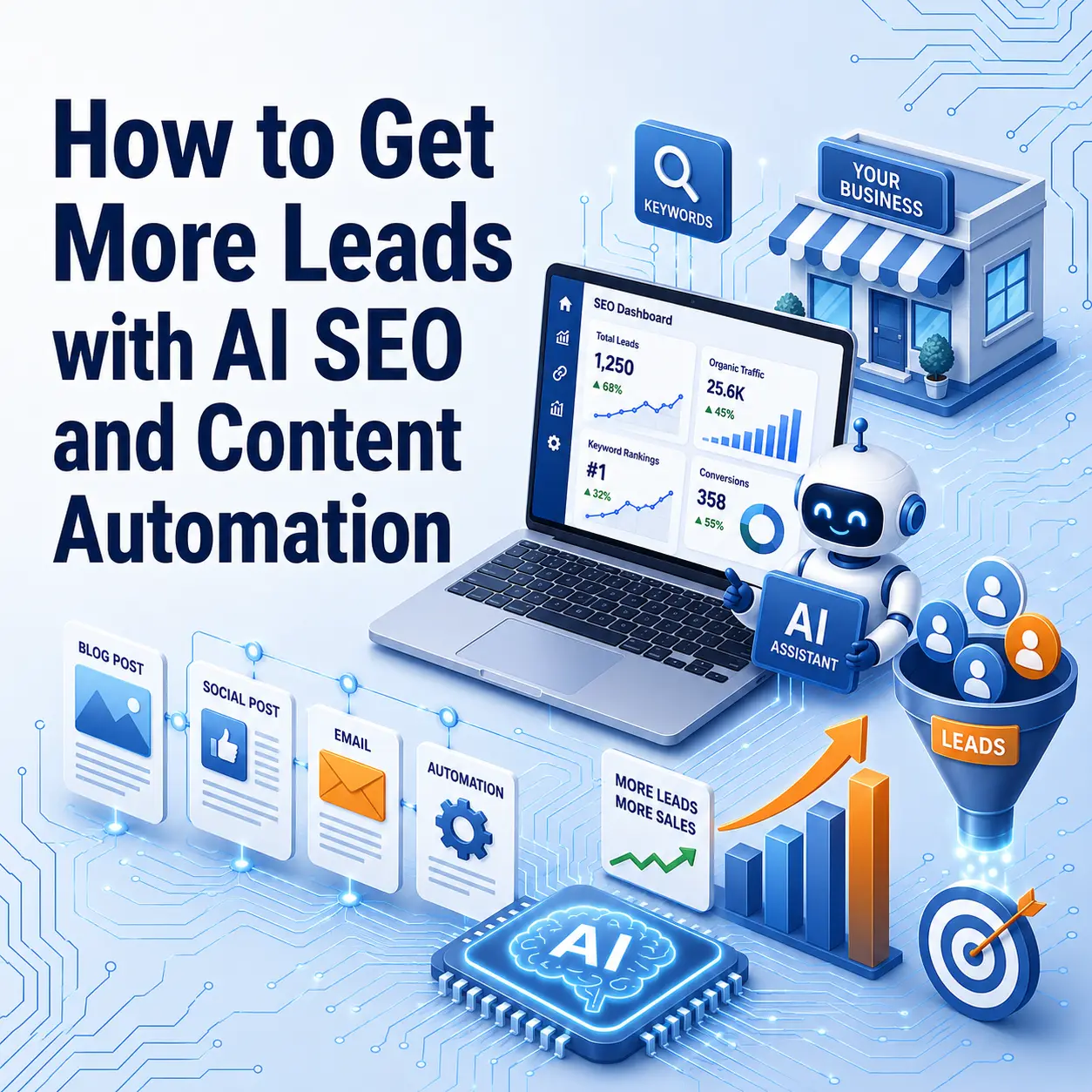
Getting more website traffic is useful, but traffic alone does not grow a business. A website can attract thousands of visitors and still produce very few calls, appointments, quote requests, or purchases. The real goal of search marketing is to attract the right people, answer their questions, earn their trust, and guide them toward taking action.
AI SEO and content automation can make that process faster and more consistent. However, simply using artificial intelligence to publish more blog posts is not a complete strategy. Businesses get better results when AI connects every stage of the customer journey, from keyword research and content creation to lead capture, follow-up, appointment booking, and performance tracking.
Google’s current guidance supports using generative AI as part of the content process, provided the resulting content is accurate, relevant, useful, and created for people. Google also warns that producing large numbers of low-value pages may violate its policies against scaled content abuse. In other words, AI can support a strong SEO strategy, but automation cannot replace expertise, quality control, or a clear understanding of the customer.
For small and established service businesses, the opportunity is significant. AI SEO can uncover what prospective customers are searching for, while content automation can help the business publish, distribute, and improve content consistently. When those systems connect to a customer relationship management platform, automated texting, email follow-up, web chat, and scheduling, more website visitors can become qualified leads.
What Is AI SEO?
AI SEO is the use of artificial intelligence to support and improve search engine optimization. It can help businesses analyze search behavior, identify keyword opportunities, evaluate competitors, organize content, optimize existing pages, detect technical problems, and measure performance.
Traditional SEO often involves manually reviewing spreadsheets, search results, competitor pages, analytics reports, and website data. These tasks remain important, but AI can process larger amounts of information faster. It can identify patterns that may be difficult to notice manually, such as groups of related searches, gaps in a website’s content, weak internal linking, declining pages, or topics that attract visitors but fail to generate leads.
AI SEO does not mean allowing software to make every decision. An AI platform may suggest a keyword, but a business owner or marketing strategist still needs to determine whether that keyword relates to a profitable service. It may recommend a content topic, but someone with real industry knowledge must confirm that the information is accurate and useful.
The best AI SEO systems combine automated analysis with human judgment. AI handles repetitive work, while experienced people make decisions about strategy, positioning, accuracy, and customer needs.
What Is Content Automation?
Content automation uses software and AI to manage parts of the content marketing process. Depending on the system, it may assist with research, editorial planning, drafting, optimization, publishing, distribution, repurposing, and reporting.
For example, one detailed blog article can be transformed into several related marketing assets. The article may become an email newsletter, a series of social posts, a short educational video script, an FAQ section, a downloadable checklist, and several follow-up messages for prospective customers.
Perfect Business AI’s content marketing system is designed around this type of connected workflow. Its services include AI-assisted content creation, SEO optimization, multi-channel distribution, content repurposing, performance tracking, and continuous improvement. Perfect Business AI also offers CRM, web chat, smart texting, email marketing, review management, and appointment-related automation, allowing content and lead follow-up to operate within the same broader business system.
The purpose of content automation should not be to flood the internet with generic articles. Its purpose is to remove repetitive work, maintain consistency, and help a business get more value from every useful piece of content it creates.
Why AI SEO and Content Automation Work Better Together
SEO and content marketing are often treated as separate activities. One person researches keywords, another writes articles, someone else posts on social media, and the sales team follows up with leads. When those activities are disconnected, opportunities are lost.
AI SEO identifies what potential customers want to know. Content automation turns that information into publishable resources. Conversion tools capture the visitor’s information. CRM and communication automations continue the conversation.
A connected system may work like this:
- AI identifies a high-intent customer question.
- A detailed, expert-reviewed article is created around that question.
- The article links to a relevant service page.
- A call to action invites the visitor to request an assessment, quote, guide, or appointment.
- The visitor submits a form or starts a web chat.
- The lead enters the CRM and receives an immediate response.
- Automated text and email messages continue the follow-up.
- The lead books an appointment or speaks with a team member.
- Performance data is used to improve the content and follow-up process.
Each part supports the next. The article is not published simply to increase the website’s page count. It has a defined role in attracting and converting a specific type of customer.
Start with Customer Intent, Not Content Volume
One of the most common mistakes in AI content marketing is measuring progress by the number of articles published. A business may publish 50 posts, but if those posts target irrelevant or overly broad topics, they may produce little revenue.
A stronger strategy starts with search intent. Search intent is the reason behind a person’s query. It helps reveal whether someone is gathering basic information, comparing solutions, evaluating a provider, or preparing to make a purchase.
Consider the difference between these searches:
- “What is marketing automation?”
- “Best marketing automation for service businesses”
- “AI marketing agency for contractors”
- “Book an AI marketing consultation”
The first search is educational. The last search has stronger commercial intent. Both can be useful, but they should not receive the same content or call to action.
Match Content to the Buyer’s Journey
At the awareness stage, a potential customer is trying to understand a problem. Educational blog posts, guides, definitions, and checklists can attract these visitors.
At the consideration stage, the visitor is comparing approaches. They may search for comparisons, costs, benefits, timelines, common mistakes, or alternatives. Detailed service guides, comparison articles, case studies, and frequently asked questions work well here.
At the decision stage, the customer wants to evaluate a provider. Service pages, pricing explanations, testimonials, team information, demonstrations, consultation pages, and location-specific pages become more important.
AI can help group keywords by these stages. That prevents a business from creating a library filled with general informational articles while neglecting pages that support actual buying decisions.
Build a Content Strategy Around Revenue Opportunities
Keyword search volume can be misleading. A high-volume keyword may generate visitors from across the country who have no realistic chance of becoming customers. A lower-volume phrase related to a valuable service and a specific service area may produce fewer visitors but more qualified leads.
A useful content plan should begin with the company’s most important services. For each service, identify the problems it solves, the questions customers ask, the concerns that delay a purchase, and the factors that influence the final decision.
For example, a company offering AI receptionist services could build content around missed calls, after-hours lead response, appointment scheduling, customer service costs, call handling, lead qualification, and automated follow-up. Each topic supports the main service while addressing a genuine customer concern.
The same principle applies to electricians, chiropractors, insurance agencies, law firms, home service companies, healthcare providers, and other service-based businesses. Content should connect customer questions to the services that create business revenue.
Create Topic Clusters Instead of Isolated Articles
A topic cluster is a group of related pages organized around a main subject. The central service page explains the primary offering, while supporting articles address narrower questions.
An AI SEO cluster for content automation might include:
- AI content automation for small businesses
- How AI SEO improves lead generation
- AI-generated content and Google search policies
- How to automate blog distribution
- AI content marketing costs
- Human-written versus AI-assisted content
- How to measure content marketing ROI
These articles should link to one another and to the relevant service page. This structure helps visitors continue learning and helps search engines understand the website’s areas of expertise.
Google recommends maintaining a clear technical and content structure for both traditional search and generative AI search experiences. Its current AI optimization guidance also emphasizes creating original, non-commodity content rather than repeating information that can be found on hundreds of other websites.
Use AI to Create Better Content, Not Generic Content
AI can produce a readable first draft quickly. That does not mean the first draft should be published without review.
Generic AI content usually has several weaknesses. It repeats basic advice, makes unsupported claims, lacks real examples, uses vague language, and fails to reflect the company’s actual experience. It may be grammatically correct but still provide little reason for a customer to trust the business.
High-performing content requires business-specific information. This may include service processes, customer questions, project examples, common mistakes, local conditions, timelines, pricing factors, technical explanations, and lessons learned from real client work.
Build Expert Input into the Workflow
Before drafting an article, gather information from people who understand the service. A short interview with the owner, salesperson, technician, or customer service team can provide valuable details.
Ask questions such as:
- What questions do customers ask before buying?
- What misconceptions create problems?
- What mistakes cost customers time or money?
- What does your company do differently?
- What should customers prepare before contacting you?
- What signs indicate that professional help is needed?
- What happens during your service process?
AI can organize these answers into an article, but the expertise comes from the business. This is how automated content becomes specific, useful, and difficult for competitors to copy.
Review Every Important Claim
Content should be checked for factual accuracy, especially in industries involving health, finance, insurance, law, electrical work, or public safety. AI may misunderstand a regulation, use outdated information, or provide advice that does not apply in a particular state.
A reliable quality-control process should verify statistics, dates, technical statements, local requirements, product details, and citations. The final article should also be reviewed for clarity, tone, originality, and alignment with the company’s services.
This review process supports E-E-A-T: experience, expertise, authoritativeness, and trustworthiness. Although E-E-A-T is not a simple ranking score, the principles are useful for creating content that customers and search systems can trust.
Optimize Content for Traditional Search and AI Answers
Customers are no longer discovering businesses through only a standard list of search results. They may use Google’s AI-powered search experiences, ChatGPT, Gemini, Perplexity, voice assistants, maps, review platforms, directories, and social media.
This does not make traditional SEO obsolete. Google’s guidance for generative AI search says that foundational SEO practices remain relevant. Helpful content, crawlable pages, internal links, clear site structure, accurate business information, and technical performance still matter.
However, content should also be structured so that AI systems can understand the business and extract useful answers.
Provide Clear Answers Early
When an article targets a direct question, answer it near the beginning. Do not force the reader to scroll through a long introduction before receiving useful information.
Follow the direct answer with context, examples, exceptions, and practical guidance. This structure makes the page easier for customers to use and may make important passages easier for search systems to interpret.
Use Descriptive Headings
Headings should explain what each section covers. Avoid vague headings such as “The Future Is Here” or “Unlock Your Potential.” A heading such as “How AI Content Automation Improves Lead Follow-Up” gives readers and search systems more information.
Strengthen Entity Information
Search and AI systems need to understand who the business is, what it offers, where it operates, and why it is credible. That information should be consistent across the website, Google Business Profile, directories, social profiles, review platforms, and other trusted sources.
Important website information includes the business name, phone number, address or service area, services, team members, professional credentials, customer reviews, case studies, policies, and contact methods.
Add Appropriate Structured Data
Structured data provides search engines with explicit information about a page. Depending on the page and business, appropriate markup may include Organization, LocalBusiness, Service, Article, BreadcrumbList, VideoObject, or other supported types.
Google recommends using accurate structured data that represents visible page content. It also advises validating the markup and prioritizing complete, correct information rather than adding large amounts of incomplete data.
Schema does not guarantee rankings or rich results. It improves clarity by helping search engines interpret the content and its relationship to the business.
Turn Every Article into a Lead-Generation Asset
A blog post should do more than educate. It should help the visitor take a logical next step.
The appropriate next step depends on the visitor’s intent. Someone reading a beginner’s guide may not be ready to schedule a sales call, but they may download a checklist or request an assessment. Someone reading a service comparison or pricing article may be ready to speak with a representative.
Each page should have one primary conversion goal. Too many unrelated calls to action can create confusion.
Possible calls to action include booking a strategy session, requesting a quote, starting a web chat, downloading a guide, checking eligibility, requesting an audit, calling the business, or joining an email list.
The call to action should match the article. A post about AI search readiness could offer a website readiness assessment. A post about missed calls could offer an AI receptionist demonstration. A post about content automation could invite the reader to request a customized content plan.
Improve the Conversion Path
A visitor should not have to search for a way to contact the company. Forms, phone numbers, chat tools, and booking buttons should be easy to find and use on mobile devices.
Keep forms appropriate to the offer. A simple consultation request may need only a name, email address, phone number, company name, and short description. Asking for too much information can reduce completions.
Trust signals should appear near important calls to action. These may include verified reviews, testimonials, case studies, years of experience, professional credentials, security statements, response-time expectations, and clear explanations of what happens after the form is submitted.
Use Automation to Respond While the Lead Is Interested
Generating a lead is only the beginning. The business must respond quickly and continue the conversation.
A prospect who requests information may also contact several competitors. If the business waits until the next day to respond, the customer may already have booked an appointment elsewhere.
Perfect Business AI positions its platform around connecting lead generation with customer engagement. Its website describes tools for web chat, automated sales follow-up, smart texting, email communication, appointment booking, CRM management, reputation management, and missed-call response.
A practical automated lead workflow may include an immediate confirmation text, an email with the requested information, a notification to the appropriate team member, a booking link, and follow-up messages if the person does not respond.
Automation should support the customer rather than overwhelm them. Messages should be helpful, relevant, and spaced appropriately. Customers should also have a clear way to speak with a person.
Route Leads Based on Their Needs
Not every lead should receive the same sequence. Someone requesting emergency service needs a different response from someone downloading an educational guide.
AI and CRM automation can help classify leads based on the page visited, form submitted, service requested, location, urgency, and previous interactions. This allows the business to send more relevant information and direct urgent opportunities to the right team member.
Repurpose Content Across Multiple Channels
Creating a strong article requires research and expertise. Publishing it once and forgetting about it wastes much of its value.
Content automation can turn one central article into several related assets without starting from zero every time. A 2,000-word guide may produce an email series, several social posts, a short video script, a downloadable checklist, sales-team talking points, customer FAQs, and follow-up messages.
Repurposing improves consistency because every channel communicates the same core message. It also allows customers to discover the business in the format they prefer.
The repurposed material should still be adapted to each platform. A LinkedIn post should not simply repeat an entire blog section. An email should include a clear reason to click. A video script should sound natural when spoken. A social post should focus on one useful insight instead of summarizing everything.
Update Existing Content Before Publishing More
Content automation is often associated with creating new articles, but updating existing pages can produce faster results.
A website may already have pages that rank near the top of the second page, attract traffic without conversions, contain outdated information, or compete against another page on the same website. AI can help identify these opportunities.
An effective content update may involve improving the introduction, adding expert details, answering missing questions, updating examples, fixing internal links, improving the call to action, consolidating overlapping pages, or adding a useful visual.
Businesses should also review older claims, dates, screenshots, service descriptions, team information, and statistics. An outdated page can weaken customer trust even if it continues to rank.
Measure Leads, Not Just Rankings
Rankings and traffic are useful indicators, but they are not the final business outcome. An AI SEO program should be evaluated based on qualified leads, booked appointments, sales opportunities, customer acquisition costs, and revenue.
Track which landing page introduced the lead, which content the person viewed, which call to action they used, how quickly the company responded, and whether the lead became a customer.
Important performance measures include:
- Organic leads by service
- Conversion rate by landing page
- Cost per qualified lead
- Appointment-booking rate
- Lead response time
- Sales close rate
- Revenue influenced by organic search
- Assisted conversions from content
- Returning visitors and branded searches
- Performance of automated follow-up sequences
This information helps the business make better content decisions. A page with modest traffic and a strong conversion rate may deserve more attention than a high-traffic page that produces no leads.
A Practical 90-Day AI SEO and Content Automation Plan
During the first 30 days, focus on strategy and infrastructure. Confirm the company’s priority services, target customers, service areas, revenue goals, and current conversion process. Audit the website for technical issues, weak service pages, missing calls to action, inconsistent business information, and content gaps. Set up accurate conversion tracking before making major changes.
During days 31 through 60, improve the pages closest to revenue. Strengthen the main service pages, clarify the value proposition, add trust signals, improve calls to action, and connect forms, chat, CRM, texting, and email follow-up. Create a small group of high-intent supporting articles rather than publishing a large volume of general content.
During days 61 through 90, expand and refine the system. Repurpose successful articles, update underperforming pages, strengthen internal linking, improve local visibility, and review lead quality. Use actual conversion data to decide which topics and services should receive additional investment.
The system should continue to improve after the first 90 days. SEO compounds as useful content earns visibility, internal links strengthen important pages, customer reviews increase trust, and performance data improves future decisions.
Common AI SEO and Content Automation Mistakes
The first mistake is publishing too much generic content. More pages do not automatically create more authority. Every page should serve a specific customer need and connect to the business’s expertise.
The second mistake is targeting keywords without considering commercial value. A keyword may be relevant to the industry but unrelated to the company’s target customer, location, or service model.
The third mistake is removing human review. AI can assist with research and drafting, but subject-matter experts should validate important information.
The fourth mistake is ignoring conversion design. Rankings will not produce strong results if the page has no clear offer, weak trust signals, or a difficult contact process.
The fifth mistake is delaying follow-up. A lead-generation strategy is incomplete when inquiries sit unanswered in an inbox.
The sixth mistake is automating every interaction without considering the customer experience. Good automation makes communication faster and more relevant. Bad automation sends repetitive messages that feel disconnected from the customer’s needs.
The final mistake is measuring only traffic. The business should know which content creates qualified opportunities and revenue.
How Perfect Business AI Connects Search Visibility to Lead Growth
Perfect Business AI offers a combination of AI SEO, content marketing, website optimization, web chat, smart texting, CRM, email marketing, review management, and appointment-related automation. This combination addresses both sides of lead generation: attracting potential customers and responding after they engage.
For a business owner, the value of an integrated system is operational. The content strategy does not sit in a separate document while leads enter unrelated tools. Search visibility, website conversion, communication, and customer follow-up can support one measurable process.
That integration is especially valuable for service businesses where customers expect fast answers. A useful article may introduce the company, but an immediate text response, convenient booking option, helpful email, or live conversation may be what turns interest into an appointment.
The strongest AI marketing strategy is not defined by how much content it creates. It is defined by how effectively it moves the right customer from a search question to a business conversation.
Conclusion
AI SEO and content automation can help businesses attract more qualified leads, but only when they are built around customer intent, expertise, conversion, and follow-up.
The process begins by identifying valuable customer searches. AI can then help organize topics, analyze competitors, improve existing pages, and support content creation. Human expertise ensures that the final material is accurate, specific, and trustworthy. Clear calls to action turn visitors into inquiries, while CRM, text, email, chat, and scheduling automations help the business respond while the lead is still interested.
Businesses should avoid using AI as a shortcut for producing large amounts of generic content. Google’s current guidance continues to prioritize helpful, reliable, people-first information, including within AI-powered search experiences. Sustainable results come from publishing useful content, maintaining a technically sound website, demonstrating real expertise, and measuring business outcomes rather than page counts.
When AI SEO and content automation operate as one connected system, content stops being a monthly marketing task. It becomes an active lead-generation asset that attracts prospects, answers their questions, builds confidence, and guides them toward becoming customers.