
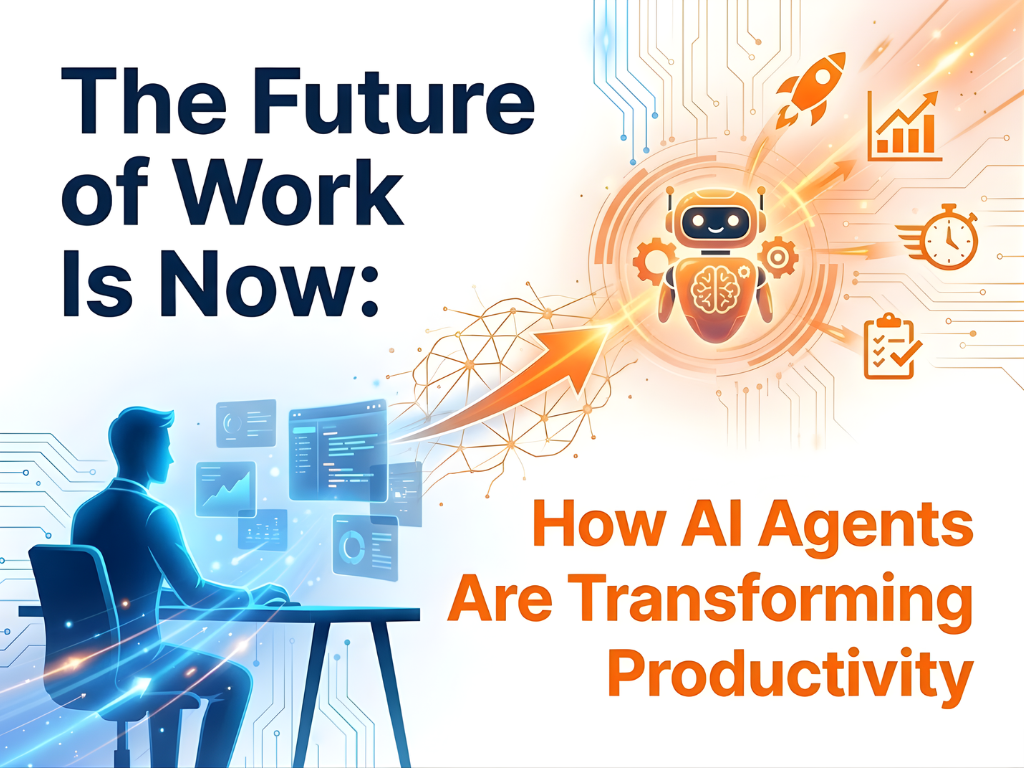
AI agents are autonomous software programs that handle complex tasks without constant human oversight, fundamentally changing how teams operate. These intelligent systems execute workflows, make decisions, and collaborate across tools, delivering productivity gains that compound over time. Businesses adopting them early report measurable efficiency improvements across departments, positioning them ahead in competitive markets.
What Are AI Agents?
AI agents differ from traditional chatbots or simple automation scripts by operating independently through planning, reasoning, and tool integration. They break down goals into steps, access data sources, execute actions, and adapt based on outcomes. In workplaces, agents manage everything from email triage to sales pipeline updates, freeing humans for strategic oversight.
Core components include natural language understanding for instructions, memory for context retention, and APIs for interacting with enterprise systems like CRMs or databases. Modern agents, powered by large language models, now handle multi-step processes such as generating reports, resolving customer tickets, or optimizing schedules with minimal input.
This autonomy shifts work dynamics. Employees delegate routine execution while focusing on judgment and creativity. Companies like Telus have employees saving 40 minutes per AI interaction by assigning tasks to specialized agents.
The Shift from Tools to Teammates
AI agents evolve beyond assistive tools into proactive partners. Gartner predicts 40% of enterprise applications will embed task-specific agents by end of 2026, turning assistants into workflow orchestrators. They monitor progress, adjust plans, and coordinate with other agents, mimicking team collaboration.
In practice, this means agents handle end-to-end processes. A sales agent qualifies leads, updates CRM records, and drafts follow-up emails autonomously. HR agents process onboarding by pulling documents, scheduling interviews, and notifying stakeholders. This reduces context switching, a major productivity killer, allowing humans to oversee multiple threads simultaneously.
Surveys confirm impact: 66% of 245 companies using agents reported productivity increases, with customer support agents resolving 14% more issues per hour—up to 34% for novices. Humans paired with agents outperform human-only teams by 73% in task throughput.
Key Ways AI Agents Boost Productivity
Automating Repetitive Workflows
Routine tasks consume disproportionate time. AI agents eliminate this by executing them flawlessly. IBM’s AskHR resolves 94% of employee queries without human involvement, speeding manager tasks like promotions by 75%. In customer service, agents manage 70% of inquiries, cutting complex case resolution by 26%.
Manufacturing firms use agents for predictive maintenance, analyzing sensor data to schedule repairs preemptively. Retailers deploy them for inventory management, forecasting demand and reordering stock across suppliers. These applications yield consistent outputs, reducing errors from fatigue or oversight.
Enhancing Decision-Making
Agents access vast data silos instantly, surfacing insights for real-time decisions. Suzano’s agent translates natural language to SQL, slashing query times by 95% for 50,000 employees. Finance teams use agents to scan transactions, flag anomalies, and simulate scenarios.
Decision intelligence emerges as agents propose options with rationales. A marketing agent analyzes campaign data, suggests A/B tests, and predicts ROI based on historical patterns. This empowers non-experts to make specialist-level calls, democratizing expertise across organizations.
Enabling Multi-Agent Collaboration
Single agents excel at isolated tasks; teams of agents tackle complexity. In software development, squads document code, generate features, review outputs, and test—cutting effort by over 50% under human supervision. Cisco envisions AgenticOps where network agents detect issues, correlate causes, and remediate autonomously.
Sales exemplifies this: One agent researches prospects, another nurtures leads, a third handles objections via email or chat. Orchestration layers ensure seamless handoffs, scaling human capacity without proportional hiring.
Real-World Use Cases Across Industries
Customer Service and Support
Agents resolve issues proactively. They classify tickets, retrieve order histories, and execute refunds or escalations. Bernard Marr highlights automated resolution as a top use case, transforming support from reactive to predictive. Logistics firms track shipments end-to-end, notifying customers preemptively.
Resolution rates climb as agents handle nuance through sentiment analysis and context memory. Complex cases route to humans with full summaries, minimizing ramp-up time.
Sales and CRM Management
Sales agents qualify leads by scanning emails, LinkedIn profiles, and past interactions. They score opportunities, personalize outreach, and log activities automatically. This frees reps for closing deals, with pipelines updating in real time.
B2B teams see pipeline velocity increase as agents nurture dormant leads with tailored content, triggered by behavioral signals.
HR and Internal Operations
Beyond AskHR, agents streamline recruiting by screening resumes, scheduling interviews, and assessing cultural fit via video analysis. Procurement agents compare vendor bids, negotiate terms within guidelines, and track compliance.
Finance agents reconcile accounts, generate forecasts, and audit expenses. IBM estimates 4.5 billion dollars in gains from agent deployment across 270,000 employees.
Productivity Metrics and Evidence
Studies quantify gains precisely. Customer support trials showed 14% average productivity lift, highest among novices at 34%. Enterprises report cycle time reductions—like claims processing from 3.4 to 2.1 days.
Cognitive benefits include less context switching and more planning time. Workers specify high-level goals; agents execute details. This elevates roles toward strategy. Business outcomes follow: lower costs per task, faster throughput, higher satisfaction scores.
Not all gains uniform—experts see modest lifts as agents excel on routine work, while novices leap ahead. Overall, agentic workflows expand capacity without headcount growth.
Challenges in Agent Adoption
Integration and Reliability
Agents require enterprise access, raising hurdles. Legacy systems demand APIs; data silos hinder performance. Early failures stem from poor integration, but platforms like Google Cloud’s Gemini Pro address this via natural language interfaces.
Reliability demands oversight. Agents err on ambiguity or edge cases, necessitating human review loops. Deloitte notes many implementations fail without treating agents as managed workers.
Skill Gaps and Change Management
Teams must learn prompting and evaluation. Novices benefit most, but veterans adapt slower. IDC emphasizes human systems—processes, ethics, oversight—for success. Mature AI centers compete 20% better on innovation.
Cultural resistance arises from job fears, though evidence shows augmentation, not replacement. Upskilling focuses on agent orchestration.
Ethical and Security Concerns
Autonomy amplifies risks: biased decisions, data leaks, hallucinated outputs. Governance frameworks mandate transparency, audit trails, and fairness checks. Regulations evolve, demanding compliance.
Edge AI mitigates latency and privacy by processing locally, as Cisco predicts for smart buildings.
Strategies for Successful Implementation
Start Small, Scale Smart
Target high-value, verifiable workflows: documentation, lead qualification, scheduling. Measure baselines—tasks per hour, error rates—pre- and post-deployment
Pilot with cross-functional teams for diverse feedback. IBM’s rollout prioritized HR for quick wins.
Optimize Prompting and Integration
Use plan-first prompting: Agents outline steps before execution, enabling early corrections. Embed in workflows via APIs, not silos. Connect to CRMs, email, databases for end-to-end value.
Build Human-Agent Teams
Supervisory roles emerge: Humans set policies, evaluate outputs, intervene strategically. Multi-agent systems distribute tasks logically.
Monitor and Iterate
Track metrics: productivity, quality, intervention rates. Refine models with feedback loops. Cisco’s AgenticOps exemplifies closed-loop optimization.
The Broader Future of Work
By 2026, agents proliferate as teammates, per Microsoft. Work reorients to specification over execution. Google Cloud foresees delegation as norm, boosting output enterprise-wide.
Sustainability integrates: Agents optimize energy in buildings via sensors. Hybrid teams blend humans and silicon workers, dissolving barriers.
Productivity surges, but paradoxes emerge—AI creates oversight needs, per World Economic Forum. Success hinges on balanced adoption.
Preparing Your Organization Today
Audit workflows for agent fit. Invest in platforms supporting multi-agent orchestration. Train on collaboration, not replacement. Ethical frameworks build trust.
The future unfolds now. Agents transform productivity from incremental to exponential. Organizations adapting thrive; others lag. Forward momentum starts with one delegated task.