
Your website is your business’s hardest-working employee. It never sleeps, never calls in sick, and it’s often the first impression a potential customer gets of your brand. But here’s the thing — if your website is running on outdated tools and old logic, it’s quietly costing you customers, revenue, and credibility every single day.
AI-powered website technology has moved from “nice to have” to a genuine competitive necessity. Businesses that have integrated AI into their websites are seeing faster load times, higher conversion rates, more personalized customer experiences, and dramatically lower bounce rates. If you haven’t taken a serious look at your website’s capabilities lately, now is the time.
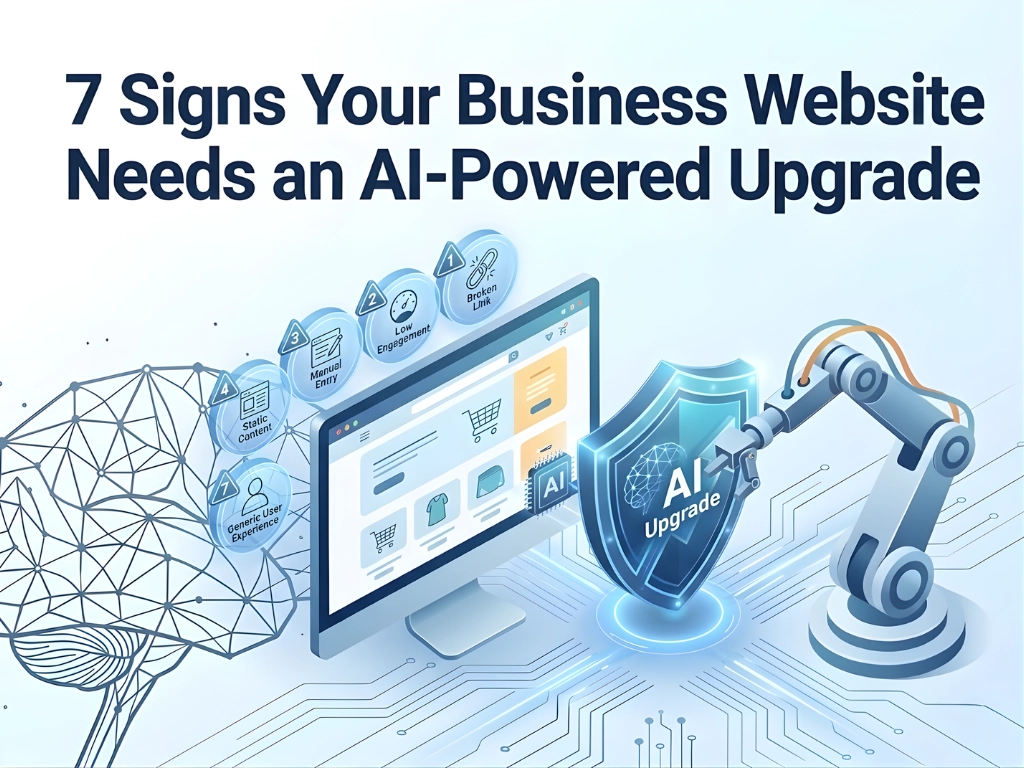
This article walks you through seven clear signs that your business website is overdue for an AI-powered upgrade — and what those upgrades can actually do for your bottom line.
Sign #1: Your Visitors Leave Without Taking Action
If your website traffic looks decent in Google Analytics but your conversions are stuck in neutral, that’s a problem. Traffic without action is just noise. When people land on your site and leave without buying, signing up, or even reaching out, it usually means one of two things: the experience isn’t personalized enough, or the site isn’t guiding them effectively toward a next step.
AI solves both of these problems. Modern AI tools can analyze visitor behavior in real time — what they click on, how far they scroll, where they hesitate — and dynamically adjust what’s shown to them based on that data. Instead of showing every visitor the same static homepage, AI can serve different content, calls to action, or product suggestions based on where the visitor came from, what device they’re using, and what their browsing behavior suggests about their intent.
This kind of dynamic personalization used to be reserved for enterprise-level companies with massive development budgets. Today, it’s accessible to small and mid-size businesses through affordable, practical platforms and plugins.
Sign #2: Your Customer Support Is Bottlenecked
Think about the last time a customer reached out to your business with a question. How long did it take to respond? If the answer is “a few hours” or “the next business day,” you’re already behind. Research consistently shows that response time is one of the top factors influencing purchase decisions, especially when someone is comparing multiple vendors at once.
AI-powered chatbots and virtual assistants have become incredibly sophisticated. They don’t just answer FAQs anymore — they can qualify leads, collect contact information, book appointments, process basic orders, escalate complex issues to a human agent, and do all of this at 2 AM on a Sunday when no one on your team is available.
The difference between a business with an AI chatbot and one without it is like the difference between a store with a knowledgeable staff member at the door versus one where customers have to search the entire building just to find help. One of those experiences builds trust and drives sales. The other one drives people out the door.
For businesses in competitive markets, a well-configured AI assistant on your website can be the difference between capturing a lead and losing it to a competitor who responded faster.
Sign #3: Your Search Rankings Have Stagnated or Dropped
SEO isn’t a one-time setup. Google’s algorithm updates constantly, and what worked for your rankings two years ago might actually be hurting you today. If your organic traffic has plateaued or declined, your content strategy and on-page optimization likely need a serious overhaul — and AI can significantly accelerate that process.
AI-powered SEO tools can analyze your entire website and surface specific issues that are dragging down your rankings. More importantly, they can identify keyword gaps, topic clusters your competitors are ranking for, and content opportunities your current strategy is missing entirely. Some tools can even generate structured content briefs or full draft articles optimized around specific search intent.
Beyond content, AI tools help with technical SEO as well — flagging broken links, duplicate content, slow page speeds, and crawlability issues that often go unnoticed until they’ve caused real damage.
If your website has good content but inconsistent traffic, AI-assisted SEO analysis is one of the fastest ways to diagnose the issue and build a clear path forward.
Sign #4: Your Website Treats Every Visitor the Same
Static websites treat a first-time visitor the same way they treat a returning customer who’s about to make a purchase. That’s a missed opportunity at every level of the funnel. A first-time visitor needs education and trust-building. A returning visitor who’s already browsed your pricing page three times needs a clear, compelling reason to act now.
AI-powered personalization engines track user behavior across sessions and serve content that matches where each visitor is in their decision-making journey. This includes personalized product recommendations, targeted promotional banners, custom landing page content, and email follow-up sequences triggered by specific on-site actions.
This isn’t surveillance — it’s smart marketing. Customers actually respond positively to experiences that feel relevant to them. According to multiple industry studies, personalized website experiences consistently outperform generic ones in both engagement and conversion metrics. If your website is still operating on a “one size fits all” model, you’re leaving a meaningful amount of revenue on the table every month.
Sign #5: You’re Spending Too Much Time on Repetitive Tasks
Running a business is demanding, and your time is one of your most limited resources. If you or your team are spending hours every week manually responding to the same customer questions, updating product information, generating basic reports, or performing routine content updates, that’s time that could be spent on higher-value work.
AI automation changes this equation dramatically. Here are some of the repetitive website-related tasks that AI tools handle efficiently:
- Responding to common customer inquiries through trained chatbots
- Sending follow-up emails triggered by specific visitor behaviors like cart abandonment
- Updating inventory displays or pricing in real time based on external data
- Generating weekly traffic and performance summaries without manual reporting
- Flagging low-performing pages for content review based on engagement metrics
When these tasks run on autopilot, your team gets back hours that can be redirected toward strategy, relationship-building, and work that actually requires human judgment. The return on investment here isn’t just financial — it’s operational.
Sign #6: Your Website Data Isn’t Helping You Make Better Decisions
Most business owners have access to website analytics. Far fewer actually know how to use that data to make clear, actionable decisions. Standard analytics platforms tell you what happened — how many visitors, which pages they visited, and where they dropped off. But they don’t always tell you why it happened or what you should do about it.
AI analytics tools go further by identifying patterns in your data that human analysis would likely miss. They can correlate specific traffic sources with conversion outcomes, identify which content types drive the most qualified leads, predict which visitors are most likely to convert based on behavioral signals, and surface anomalies that indicate something has gone wrong — like a sudden drop in traffic after a site update.
This level of insight changes how you make decisions about your marketing budget, your content calendar, and your website design. Instead of guessing which changes will move the needle, you’re acting on evidence.
If your current approach to website data is logging into Google Analytics once a month and looking at traffic numbers, you’re only seeing a fraction of what’s actually happening on your site. AI-powered analytics platforms surface the full picture and give you clear recommendations, not just raw numbers.
Sign #7: Your Competitors Are Getting Faster and Smarter
This one is less about your website specifically and more about market reality. If your competitors are already using AI to personalize their user experiences, improve their customer support response times, optimize their content for search, and automate their follow-up sequences — and you’re not — the gap between your business and theirs is growing every month.
AI adoption on small- and mid-sized business websites has accelerated sharply over the past two years. What was once experimental is now standard practice in many industries. Businesses that waited too long to adopt e-commerce in the early 2000s or mobile optimization in the 2010s learned an expensive lesson about what happens when you ignore a major shift in how customers expect to interact with businesses online.
The current shift toward AI-powered websites is that same kind of moment. The barrier to entry is lower than ever. The tools are more accessible, more affordable, and more effective than ever. Waiting for this to “mature more” is a strategy that benefits your competitors, not you.
How to Know If You’re Behind Your Competitors
A quick competitive audit can tell you a lot. Spend some time on your top three competitors’ websites and look for:
- Live chat or AI chat widgets that respond instantly
- Personalized product or service recommendations
- Dynamic content that changes based on browsing behavior
- Fast-loading, mobile-optimized experiences with clear conversion paths
If you’re seeing these features on competitors’ sites but not on your own, that gap is already affecting how customers perceive you compared to the alternatives they’re considering.
What an AI-Powered Upgrade Actually Looks Like
An AI-powered website upgrade doesn’t mean tearing everything down and starting over. In most cases, it means integrating smart tools into your existing infrastructure in a phased, strategic way. The right starting points depend on your specific business model, your current tech stack, and where you’re losing the most ground right now.
Common Starting Points for AI Website Integration
For most small and mid-size businesses, the highest-impact AI upgrades fall into a few core areas:
- Conversational AI: A trained chatbot or virtual assistant that handles common inquiries, qualifies leads, and books appointments around the clock
- Personalization tools: Software that tailors content, offers, and CTAs based on visitor behavior and segmentation data
- AI-assisted SEO: Tools that identify content gaps, optimize existing pages, and track ranking opportunities with greater precision than manual research
- Predictive analytics: Platforms that move beyond basic reporting to surface actionable insights about visitor behavior and conversion potential
The key is not to implement everything at once. Start with the area where you’re losing the most — whether that’s support response time, conversion rates, or search visibility — and build from there.
The Real Cost of Waiting
Every month your website operates without AI capabilities is a month of missed conversions, slower response times, and ceding ground to competitors who are already using these tools. The cost of inaction isn’t just hypothetical — it shows up in your bounce rates, your support ticket volume, your ad spend efficiency, and ultimately, your revenue.
AI-powered websites aren’t about replacing the human side of your business. They’re about making the digital front door of your business smarter, faster, and more responsive so that when someone arrives ready to engage, your website is ready to meet them exactly where they are.
The businesses that are winning right now aren’t necessarily the ones with the biggest budgets. They’re the ones using available technology intelligently to create better experiences and operate more efficiently than the competition.
Conclusion
If you recognized your website in any of the seven signs described above, that’s not a reason for concern — it’s a reason to act. The good news is that AI-powered website tools are more accessible today than ever, and the path from “outdated” to “competitive” doesn’t have to be complicated or expensive.
Start by identifying the one or two areas where your website is creating the most friction — whether that’s low conversions, slow support response, stagnant SEO, or poor use of data — and begin there. A focused, strategic AI upgrade in those areas will deliver measurable results faster than a sweeping overhaul, and it gives you a foundation to build on.
At perfectbusinessai.com, we help businesses like yours identify exactly where AI can make the biggest difference and implement the right tools to get there. If your website has been running on autopilot for too long, now is the right time to give it the upgrade it and your customers deserve.