
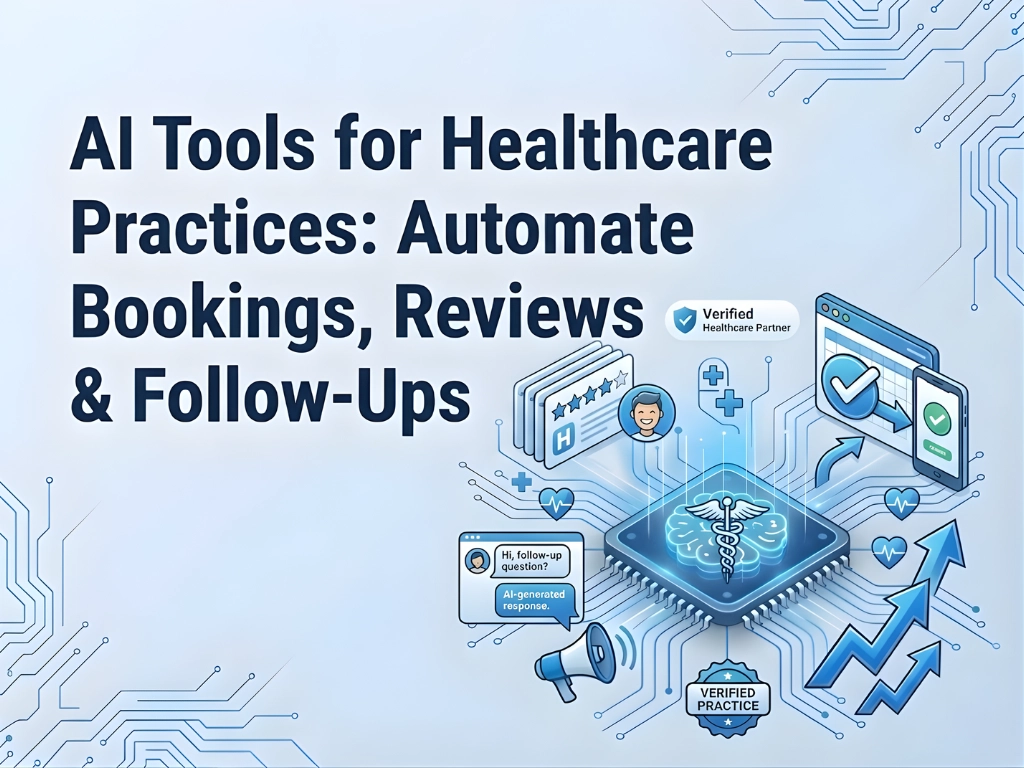
Running a healthcare practice in 2026 means wearing more hats than ever before. You’re expected to deliver excellent patient care, manage a growing administrative workload, maintain a strong online reputation, and keep your schedule full — all at the same time. For most practice owners and office managers, something inevitably slips through the cracks. Appointments get missed. Follow-up messages don’t go out. Review requests never get sent. And the front desk team spends half their day on tasks that a well-configured AI system could handle in seconds.
The good news is that AI tools built specifically for healthcare practices have matured rapidly. They’re no longer experimental or reserved for large hospital networks. Independent clinics, chiropractic offices, physical therapy practices, dental offices, and specialty providers of all sizes are now using AI to automate the operational side of their businesses — and the results are showing up in their revenue, patient retention rates, and online reputation.
This article breaks down how AI tools are changing the way healthcare practices handle bookings, reviews, and follow-ups, and why getting these systems in place now is one of the smartest investments a practice can make.
The Real Cost of Manual Operations in Healthcare
Before diving into what AI can do, it’s worth being honest about what manual operations are actually costing your practice. A front desk team member who spends three hours a day answering appointment calls, manually entering data into your practice management system, and chasing down patients for confirmations is doing work that generates zero clinical value. That same employee, freed from those repetitive tasks, could be building patient relationships, resolving billing issues, and handling work that genuinely requires a human touch.
Studies in healthcare administration consistently show that medical practices spend close to 30% of their revenue on administrative costs. A significant portion of that overhead goes toward tasks that AI can automate reliably and accurately. When you add up the staff hours spent on appointment scheduling, reminder calls, post-visit follow-ups, and review management across a full year, the number is staggering — and it compounds the longer you wait to address it.
Beyond the cost, there’s a problem with the patient experience. Today’s patients are accustomed to the kind of instant, frictionless interactions they get from apps and online retailers. When they call a healthcare office and get put on hold, or never receive a follow-up after their visit, the contrast is jarring. Many of them quietly switch to a competitor who makes the experience easier. AI bridges the gap between what patients now expect and what a small administrative team can realistically deliver.
AI-Powered Booking: Filling Your Schedule Without the Phone Tag
Scheduling is the heartbeat of any healthcare practice. An empty slot on your calendar is lost revenue that can never be recovered, and a poorly managed booking system creates friction that drives prospective patients away before they ever walk through your door.
AI booking tools integrate directly with your practice management software and allow patients to schedule appointments 24 hours a day, seven days a week, without any staff involvement. The system checks your real-time availability, confirms the appointment instantly, and sends the patient a confirmation via their preferred channel — text, email, or even WhatsApp. No phone tag, no double-booking, no manual data entry.
What makes AI scheduling genuinely powerful compared to a basic online booking widget is the intelligence behind it. AI booking tools can route appointment requests based on provider availability, appointment type, and patient history. They can handle multi-step scheduling sequences — for example, booking a pre-procedure consultation, the procedure itself, and a follow-up appointment all in one interaction. They can also manage waitlists automatically, filling canceled slots by reaching out to patients who indicated flexibility in their scheduling preferences.
For practices that field a high volume of inbound calls, the impact is immediate. One conversational AI platform reported that clinics using its booking automation saw a meaningful reduction in misbooked appointments and a significant drop in the number of follow-up calls needed to clarify scheduling details — all while supporting patient volume growth without adding administrative headcount.
What to Look for in a Healthcare Booking AI
Not all booking tools are created equal. When evaluating options for your practice, prioritize platforms that offer:
- HIPAA-compliant data handling and storage
- Real-time integration with your existing EMR or practice management system
- Multi-channel confirmation (SMS, email, and voice)
- Automated appointment reminders with customizable timing
- Waitlist management and cancellation backfill capabilities
The right tool doesn’t just fill your calendar — it reduces the no-show rate, which for many practices is one of the biggest sources of lost revenue.
Automating Patient Follow-Ups: Consistency That Builds Retention
The period after a patient’s appointment is where most practices lose the most ground. A patient leaves your office, receives no communication for two weeks, and gradually forgets to schedule their next visit. They don’t have a strong reason to come back; no one has reached out to reinforce their care plan, and when they eventually do need an appointment, they’re just as likely to search for a new provider as to call you back.
AI-powered follow-up systems eliminate this gap entirely. After each appointment, the system automatically sends a follow-up message tailored to the type of visit. Post-adjustment, post-procedure, post-consultation — each follow-up sequence can be configured to match the clinical context and guide the patient toward their next step. If the patient doesn’t respond to the initial message, the system follows up through a different channel rather than giving up after one attempt.
This kind of automated, multi-channel outreach creates a consistent communication experience that a manual process simply cannot match at scale. A practice that sees 50 patients a day cannot realistically send personalized follow-ups to every one of them by hand. An AI system can do it without adding a single minute to your team’s workday.
The downstream effect on patient retention is significant. Patients who receive timely, relevant follow-up communication feel more cared for, are more likely to adhere to their treatment plans, and are significantly more likely to rebook. For practices operating on a continuity-of-care model — chiropractic, physical therapy, mental health, dental — this directly impacts monthly recurring revenue.
The Follow-Up Metrics That Matter
AI follow-up platforms typically come with analytics dashboards that track how your outreach is performing. The metrics worth monitoring include:
- Rebooking rate after first visit
- Response rate to follow-up messages by channel
- Patient retention rate across 90-day and 180-day windows
- No-show and cancellation rates before and after automation
These numbers tell you whether your follow-up strategy is actually moving the needle — and they give you the data to refine your messaging over time.
AI-Driven Review Management: Building the Reputation That Attracts New Patients
Online reviews are the modern version of word-of-mouth referrals. When a prospective patient searches for a chiropractor, dentist, or physical therapist in their area, the first thing they look at is your star rating and the quality of your recent reviews. A practice with a 4.8-star rating and 200 recent reviews will almost always win the click over a competitor with a 4.2 and reviews from three years ago.
The challenge for most practices is not that patients are unhappy — it’s that satisfied patients don’t think to leave a review unless they’re prompted at the right moment. AI review management tools solve this by automating the request at the optimal time, which is typically shortly after a positive appointment interaction, while the experience is still fresh.
When a patient completes a visit, and their sentiment data or survey response indicates satisfaction, the AI system automatically sends a review request via SMS or email with a direct link to your Google Business Profile or preferred review platform. The timing, channel, and messaging can all be customized to match your practice’s tone. No staff member has to remember to ask, and no positive experience goes unharvested.
Beyond generating new reviews, AI tools can also monitor your review profiles across platforms and flag negative feedback for immediate follow-up. Responding quickly and professionally to a negative review has a measurable impact on how prospective patients perceive your practice — and AI can draft suggested responses that your team can review and send in minutes rather than hours.
HIPAA Compliance: The Non-Negotiable Foundation
Any AI tool used in a healthcare setting must be HIPAA compliant. This isn’t a technicality — it’s a legal and ethical obligation. When evaluating AI platforms for patient communication, scheduling, or follow-up, confirm that the vendor offers a Business Associate Agreement (BAA), uses encrypted data storage and transmission, and has a clear policy on how patient data is used and retained.
Reputable healthcare AI platforms are built with compliance as a baseline, not an afterthought. Tools like GoHighLevel, Weave, SimplePractice, and Keragon all offer HIPAA-compliant configurations specifically designed for healthcare environments. The key is to verify this directly with the vendor and ensure your team understands the compliance requirements before deploying any new system.
Cutting corners on compliance to save money on software is a trade-off that no practice can afford to make. The right AI tools protect both your patients and your practice.
How AI Tools Work Together: The Integrated Practice
The practices seeing the strongest results from AI automation aren’t using these tools in isolation. They’ve built an integrated system where booking, follow-up, and reputation management work together as a connected patient journey.
Here’s what that looks like in practice: A new patient finds your practice through a Google search, clicks on your profile (boosted by 200+ recent reviews generated through AI review requests), and books an appointment through your AI scheduling tool at 9 PM on a Tuesday. They receive an automated confirmation, a 48-hour reminder, and a day-of reminder the morning of their visit. After their appointment, they receive a personalized follow-up message with guidance relevant to their treatment. Three days later, they received a review request. Two weeks later, they receive a rebooking prompt.
Every step in that sequence happens automatically, without a single manual action from your team. The patient experiences consistent, professional, and caring communication. Your schedule stays full. Your reviews keep coming in, and your staff is free to focus on the work that actually requires them to be present.
This is what a well-implemented AI system delivers — not just efficiency, but a patient experience that builds loyalty and drives sustainable practice growth.
Getting Started Without Disrupting Your Practice
One of the most common concerns practice owners have about AI automation is the implementation process. The fear is that adopting new technology will create confusion, disrupt existing workflows, and require extensive staff retraining. In reality, most modern healthcare AI platforms are designed for easy adoption and can be integrated with existing systems through straightforward API connections.
The most practical approach is to start with one high-impact area and expand from there. For most practices, automated appointment reminders and follow-up messages offer the fastest return on investment with the least operational disruption. Once your team is comfortable with that layer of automation, adding AI-powered review management and then full booking automation becomes a natural progression.
Give your staff a clear context on what the AI is handling and why. When your front desk team understands that the AI is handling the repetitive, time-consuming tasks so they can focus on higher-value patient interactions, adoption is typically smooth and fast.
Conclusion
Healthcare practices that still manage bookings, follow-ups, and review requests manually are operating at a significant competitive disadvantage — and the gap widens with each passing month. AI tools built for healthcare are no longer a future investment. They’re a present-day operational necessity for practices that want to grow, retain patients, and build the kind of online reputation that attracts new ones.
The technology is accessible, the compliance frameworks are established, and the results are well-documented. Whether you’re a solo practitioner or managing a multi-provider clinic, the right AI automation stack can transform the administrative side of your practice without requiring a large team, a large budget, or a long implementation timeline.
At perfectbusinessai.com, we work with healthcare practices to identify exactly where AI automation will deliver the highest return and implement the tools that make it happen. If your practice is ready to stop losing patients to missed follow-ups and full your schedule without the phone tag, let’s talk about what the right system looks like for your specific situation.