
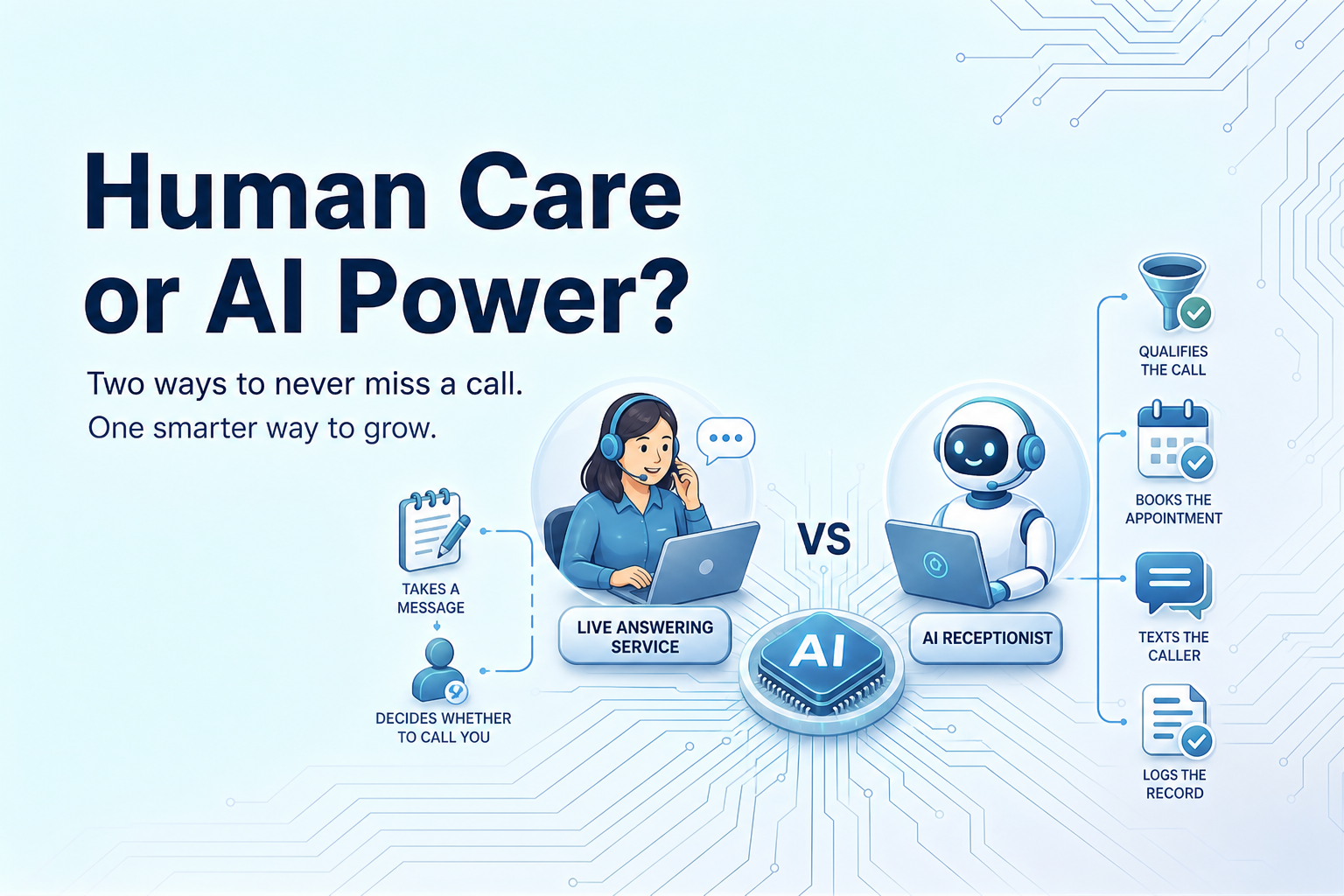
A live answering service puts a remote operator on your line who follows your script, writes a message, and decides whether to wake you. An AI receptionist answers the same call, asks your qualifying questions, books the slot, texts the caller a confirmation, and logs the record. Both are outsourced answering, not a hire. The real difference shows up after the caller hangs up: one leaves you a task, the other leaves you a booked job.
One missed call, two systems: what happens in the next 60 seconds
It is 9:40 on a Tuesday night. A homeowner has water spreading across her garage floor from a failed 50-gallon water heater. She searches on her phone, taps the first number with decent reviews, and it is yours. She will not leave a voicemail. Nobody standing in two inches of water leaves a voicemail. You have about one ring cycle before she backs out and taps the next listing. Here is what the next sixty seconds look like in each setup.
With an outsourced live answering service, the call forwards to a call centre. An operator picks up with your business name on their screen and your script in front of them. They are polite, they are human, and they have never looked at a water heater in their life. They take her name, number, address and a short description of the problem, then check your account instructions: emergency after 9pm, call the owner’s mobile; everything else, email the message. If your instructions say call, they try you. If you do not pick up, they try the second number, then file it as a message. The caller hears a real person, which counts for something, followed by some version of I will pass this along to the on-call technician. She has no appointment, no arrival window, and no idea what it costs. The per-minute meter has been running the whole time.
With an AI receptionist, the call is answered on the first or second ring. No queue, no hold music. It names your business, asks what is happening, and hears my water heater is leaking everywhere. That matches an emergency rule you wrote during setup, so it asks the three things you actually need to decide whether to roll a van tonight: is the water shut off, is it gas or electric, and what is the address. Then it does whatever you configured it to do. It either dials your mobile and connects her, or books the first slot on tomorrow’s calendar and texts her the confirmation while she is still standing there. Either way, a summary hits your phone within seconds: name, number, address, the words she used, and what was booked.
Both of these are outsourced answering. Neither is a receptionist sitting in your office. The difference is not the voice and it is not the technology. It is what each one does with the information once she hangs up. One route ends with a message you still have to act on. The other ends with a calendar entry, a contact record, and a confirmation text already in the caller’s hand.
After hours: the call that arrives when nobody is holding a phone
After-hours coverage is the reason most owners buy an answering service in the first place. The calls that arrive between five in the evening and eight the next morning are often the best ones: burst pipes, lockouts, no heat, no power. What you are paying a live service for is a person holding your script overnight so those calls meet a human voice instead of a voicemail greeting.
The weak point is the judgement call. Your script has to tell a stranger, in writing, what counts as an emergency in your trade. Write the rules loosely and you get paged at 1am for a quote on a bathroom remodel. Write them tightly and a genuine emergency sits in an inbox until morning. The operator cannot tell the difference between a dripping tank and a failed relief valve, because that is not their job. You also need an on-call rota if more than one person can be woken, and someone has to keep that rota current with the service.
An AI receptionist runs the same decision against rules you set once and can change in an afternoon. Certain phrases and situations escalate immediately. Everything else gets qualified and booked into the first open slot on the calendar, with a confirmation text sent before the caller has put the phone down. You stop being the routing layer for every after-hours enquiry.
Then there is the awkward middle case nobody plans for: the caller who does not have a true emergency but still wants an answer tonight, and who is already scrolling to the next company. A message slip does nothing for that caller. A booked appointment ends the shopping. That single difference is the one most owners feel first after switching.
Mid-job: the second call while you are already on the first
Most owners buy answering coverage for nights and weekends, then discover the bigger leak is in the middle of a Tuesday. You are under a sink with both hands wet. You are on the phone with a supplier. The office line is engaged because someone is asking about an invoice. Every one of those is a missed call that never shows up as a missed call, because the caller simply dials someone else.
A live service handles overflow, but it bills for it. Every one of those daytime calls costs minutes, including the calls you would have picked up yourself if your hands had been free, and including the ones that turn out to be a supplier or a spam dialler. If two callers arrive at the same moment, one of them usually waits.
An AI receptionist answers every simultaneous call without a queue, which matters most on the days you least want to think about it: a cold snap, a storm, the week a new campaign goes live. Ten calls at once get ten answers at once.
The quieter problem is the return call. A message slip means the conversation is not finished. You still owe that person a callback, and the callback is the exact step that slips when the day runs long. You end up with a tidy list of people who contacted you and a sinking feeling about how many of them you never rang. An appointment booked during the original call removes that step entirely.
Can customers tell they are talking to AI, and does it cost you the job?
This is the question owners actually ask each other. Trades forum threads about answering services rarely turn into technology debates. They turn into two concerns: what it costs, and whether customers get annoyed. Can callers tell? is the version people type out.
Honest answer: often, yes, and it matters less than you would expect when the call goes cleanly. A caller with clear intent, a standard job type and an address to give is usually fine. They want to describe the problem, hear that someone is coming, and get a time. If the system names your business, confirms the service, offers a real slot and sends a text, most callers treat it the way they treat an online booking form with a voice.
Where callers push back is more specific. Distressed emergency callers who are talking over themselves. Multi-part questions that mix a quote, a warranty issue and a reschedule. Heavy background noise, a bad signal, a strong accent. Those calls need a fast route to a person, and the setup should be built so that route is one sentence away.
It is worth comparing that against the real live-service experience rather than an idealised one. A remote operator reading your script cannot tell a caller what it costs to replace a 50-gallon tank either. They cannot say whether you carry the part. They say a technician will call back. Callers are not comparing AI to your best office manager. They are comparing it to a call centre, or to a voicemail box.
What changes caller reaction most is not the voice. It is the greeting naming your business, the system saying early that it can book an appointment, short clear questions rather than long scripted paragraphs, and an obvious way to reach a human. Get those four right and the annoyance risk drops to something close to a well-run phone tree with better manners.
The handoff: how a call gets to an actual human in each setup
Every answering layer hits its limit eventually. What matters is what happens at that moment.
A live service has two moves. Transfer the call, or take a message. Transfers run on rules you supplied: which numbers to try, in what order, at what hours, for which call types. Warm transfers, where the operator briefs you before connecting, often cost more, and the caller holds while it happens. If nobody answers, the call collapses back into a message.
An AI receptionist has more routes, and you choose which applies to which situation:
- Live transfer to your mobile or a specific team member, used for the call types where a conversation closes the job.
- Text to the owner with the caller’s number and the gist of the request, so you can decide whether to ring back now or at the end of the job.
- Scheduled callback, where the caller picks a window and it lands on the calendar as a task rather than a loose promise.
- Escalation to a human answering layer, if you want people behind the system for the calls it cannot close.
The part worth an hour of your time at setup is the rules, not the voice. Decide what genuinely counts as an emergency in your trade, in plain words, including the phrases your customers actually use. Decide what happens during quiet hours: a pricing question at 11pm goes into the morning queue, a no-heat call in January does not. Set a second number for the nights you are unreachable. Decide which job types are worth interrupting you mid-job and which are not.
Both systems fail in the same place when they fail. Not the answering. The routing. Spend the time there and most of the complaints owners have about either model never happen.
After the call ends: the message slip versus the record
This is the widest gap between the two models, and it is the one that rarely appears in a sales comparison.
A live answering service produces a message. It arrives as an email, a text, or an entry in a portal. It is usually accurate and it is usually fast. Then the work transfers to you. You read it, you ring back, you quote, you book, you remember to follow up with the person who said they would think about it. On a normal day you do most of that. On a bad day the messages stack up, and the ones from Thursday afternoon get rung back on Monday, by which point the caller has already booked someone else.
An AI receptionist connected to your follow-up tools does something different with the same call. It writes a contact record, logs what the caller wanted in their own words, and triggers the next steps without anyone touching a keyboard:
- A confirmation text goes out within seconds of the booking, with the time, the service and your business name, so the caller has something on their phone to point at.
- A reminder goes out before the appointment, which cuts the no-shows that waste a van run.
- A follow-up text goes to the caller who did not book — the one who wanted a price or said they would check with their partner — a day or two later, while you are still the company they spoke to.
- Enquiries from the website chat land in the same place as phone enquiries, so one person is not chased twice and nobody is missed because they typed instead of called.
The missed call is only half the lost revenue in most service businesses. The other half is the message that was taken perfectly and never returned. A live service solves the first half and hands you the second. An automated receptionist with follow-up behind it closes the loop, which is the reason the two models produce different booking numbers from the same volume of calls.
AI answering service vs live answering service for small business: the cost arithmetic
The pricing models behave differently as volume moves, and that behaviour matters more than the headline rate.
Live services bill by the minute or in call blocks. That means a chatty caller costs more than a brief one. A caller who needs the address repeated three times costs more. Hold time, spam calls, suppliers, and the customer ringing to reschedule all draw down the same bucket. Most importantly, the bill rises exactly when the business is busiest. A storm week, a seasonal rush, a new campaign bringing more enquiries — all of it lands on the invoice at the same time as the extra work, so your coverage cost is highest in the months you have least time to review it.
AI answering pricing does not scale with how long people talk or how many call at once. The capacity is there whether you get four calls on Sunday or forty.
Before you decide anything, pull the last three invoices and work out:
- What you paid each month, and what drove the differences between the three.
- How many calls were handled, and how many of those were worth handling.
- Average call length, and which call types run long.
- How many of those calls turned into booked, invoiced work — not enquiries, work.
- How many messages you never returned, which is usually the uncomfortable number.
- The split between after-hours and daytime overflow, because that tells you where to start.
Those six figures tell you more about which model fits than any comparison table. An owner paying for a high volume of short daytime overflow calls is in a very different position from one paying for a handful of genuine after-hours emergencies.
What happens when the system goes down?
Owners raise this one directly. As one small business owner put it on Quora about an AI call answering service: "When it worked, it worked great but there were times when the system went down." That is a fair objection and it deserves a plain answer rather than a reassurance.
Ask any provider the same question before you sign: what happens to the call if the system cannot answer it? The answer should be a specific chain, not a promise. Calls forward to a mobile. Then to a second number. Then to voicemail-to-text, so a transcript reaches you even if nothing else did. The failover should be something you can test yourself in five minutes.
Then ask a live service the same question. Their version of downtime is staffing: hold times during a regional storm, an operator who mishears the street name, coverage gaps on a holiday weekend. Neither model is immune. The difference is whether there is a defined fallback behind it.
A short decision frame. If most of your calls are complex, negotiated or emotionally loaded, keep people on the phone. If most are standard bookings and after-hours enquiries that currently reach voicemail, run AI. Most owner-operated service businesses sit in the middle and are best served running both: AI answering first, a human escalation path behind it.
Pilot it the low-risk way. Point only your after-hours calls at the AI receptionist for a month while daytime traffic stays where it is. Compare bookings made, callers who hung up, and what your morning inbox looks like. If it holds up overnight, move the daytime overflow next.