
A potential customer may still open Google and compare traditional organic results. That same person may also read an AI Overview, ask ChatGPT for a recommendation, use Microsoft Copilot to research a service, or continue a conversation in Google AI Mode.
These experiences create several ways for a business to be discovered. A company might rank on the first page of Google, appear in a featured answer, get cited in an AI-generated response, or be mentioned as one of several recommended providers.
That shift has introduced three terms that business owners are hearing more often: SEO, AEO, and GEO.
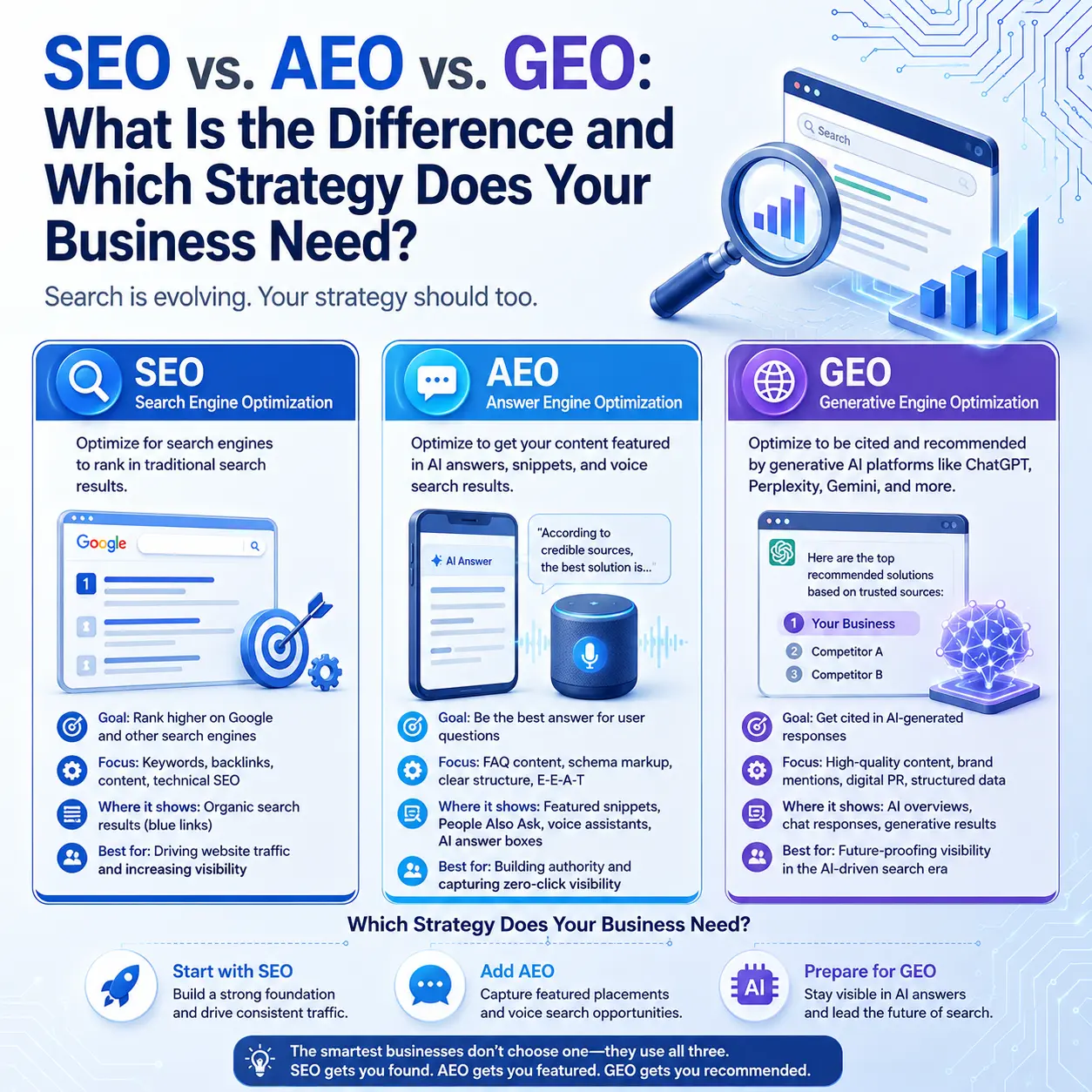
SEO stands for search engine optimization. AEO stands for answer engine optimization. GEO stands for generative engine optimization. Although marketers sometimes present them as separate services, they are closely connected. Strong AEO and GEO performance usually depends on the same technical quality, authority, relevance, and content foundation required for SEO.
Google has stated that its generative AI search features are rooted in its existing search ranking and quality systems. Bing provides similar guidance, explaining that the same crawling, indexing, content clarity, and authority signals that support traditional search visibility also support eligibility for AI-generated answers and citations.
The practical question is not whether your business should choose SEO, AEO, or GEO. The better question is how to build a search strategy that supports all three.
What Is SEO?
Search engine optimization is the process of improving a website so that search engines can discover, understand, index, and rank its pages for relevant searches.
Traditional SEO focuses primarily on visibility within organic search results. When someone searches for a service, product, company, or question, SEO helps a relevant page appear near the top of the results.
For a local electrician, that could mean ranking for “emergency electrician near me.” For a chiropractor, it might mean appearing for “sciatica treatment in Woodstock.” For a business automation company, it could mean earning visibility for “AI receptionist for small businesses.”
SEO includes several connected areas.
Technical SEO makes sure search engines can crawl and index the website. It covers issues such as site speed, mobile usability, internal links, redirects, canonical URLs, XML sitemaps, robots.txt rules, duplicate pages, and JavaScript rendering.
On-page SEO helps search engines understand the subject and purpose of each page. It includes the page title, headings, content, internal links, image descriptions, URL structure, and alignment with the searcher’s intent.
Off-page SEO builds credibility through links, reviews, citations, public mentions, partnerships, directories, and other third-party signals.
Local SEO helps a business appear in location-based searches, map results, local service searches, and Google Business Profile results.
Content SEO focuses on creating useful pages that answer the questions potential customers ask before choosing a business.
The main SEO objective is not simply to add keywords. It is to create the strongest and most relevant resource for the person searching.
What Is AEO?
Answer engine optimization is the process of making content easy for search systems to select and present as a direct answer.
AEO became important before the recent growth of generative AI. Search engines had already started answering questions through featured snippets, knowledge panels, voice assistants, People Also Ask results, calculators, local packs, and other search features.
Instead of requiring users to click through several websites, an answer engine attempts to provide an immediate response.
For example, a person might search:
“What does an AI receptionist do?”
A traditional SEO page may rank because it covers AI receptionist services in depth. An AEO-focused section would also provide a clear, self-contained explanation near the beginning of the page:
“An AI receptionist answers calls or messages, responds to common questions, qualifies leads, schedules appointments, and routes customers to the correct person without requiring a full-time staff member to handle every inquiry.”
That passage is easier for a search engine or voice assistant to extract than a long introduction that avoids answering the question directly.
AEO does not mean every page should be converted into a large FAQ. It means important questions should receive clear answers in a format both people and machines can understand.
Good AEO content usually has descriptive headings, concise opening answers, supporting details, accurate definitions, logical sections, relevant examples, and language that matches the customer’s question.
It is particularly useful for searches beginning with words such as “what,” “why,” “how,” “when,” “where,” “can,” “does,” and “which.”
AEO can help a business earn visibility even when the user does not click a traditional search result immediately. A direct answer may introduce the brand, establish expertise, and influence a later purchase decision.
What Is GEO?
Generative engine optimization is the process of improving a brand’s visibility, accuracy, and likelihood of being cited within answers produced by generative AI systems.
These systems do more than extract a sentence from one webpage. They may retrieve information from multiple sources, compare the material, synthesize an answer, and cite selected pages.
A generative engine may respond to questions such as:
“Which AI marketing tools are useful for a small home-service company?”
“What should a business automate first?”
“Compare an AI receptionist with a traditional answering service.”
“What company can help a small business improve its website, reviews, follow-up, and customer communication?”
GEO attempts to make a company’s content eligible and useful for those generated responses.
The term gained wider recognition after researchers introduced a formal GEO framework in a 2023 paper. Their research examined methods for improving how source content appeared in generative responses and reported visibility gains of up to 40% within the study’s experimental conditions. That result should not be treated as a promise that one content update will produce the same improvement on every platform. AI retrieval systems are constantly changing, and visibility can vary by query, industry, source set, and model.
GEO is broader than placing a direct answer under a heading. It also involves whether the business is consistently described across its website and third-party sources, whether its content contains original information, whether important pages are crawlable, and whether AI systems can verify the company’s claims.
A strong GEO strategy improves the chance that an AI system will understand four things:
Who the business is.
What the business offers.
Who it serves.
Why the business should be considered a reliable source.
SEO vs. AEO vs. GEO: The Main Difference
The easiest way to understand the distinction is to look at the desired outcome.
SEO aims to earn higher visibility in ranked search results.
AEO aims to have content selected as a direct answer.
GEO aims to have content or brand information included, summarized, or cited in a generative AI response.
These outcomes overlap.
A page must often be crawlable and indexed before Google can use it in its AI search experiences. It must also be relevant enough to be retrieved, clear enough to be understood, and trustworthy enough to support an answer. Google specifically notes that pages must meet normal Search technical requirements and be eligible to appear with a snippet before they can be considered for generative AI features.
Bing also explains that Copilot and other grounding experiences rely on core crawling, indexing, ranking, and content-quality foundations. Clear headings, stable URLs, focused pages, accurate information, and important details placed early on the page can support both traditional rankings and AI citations.
This is why treating SEO, AEO, and GEO as completely separate campaigns can create unnecessary work. One high-quality service page can support all three when it is properly planned.
How the Three Strategies Work Together
Consider a company offering AI receptionist services.
An SEO strategy would identify relevant searches such as “AI receptionist for small business,” create a dedicated service page, optimize its title and headings, improve internal links, and build authority around the topic.
An AEO strategy would add clear sections answering questions such as what an AI receptionist does, how it handles missed calls, whether it can schedule appointments, and how it differs from a traditional answering service.
A GEO strategy would strengthen the page with specific service details, examples, implementation information, company expertise, supporting data, consistent business information, and external references that help generative systems verify the claims.
The SEO work helps the page get discovered.
The AEO work helps the page answer specific questions.
The GEO work helps AI systems interpret, trust, summarize, and potentially cite the information.
The same principle applies to local businesses. A plumbing company may rank for “water heater repair,” answer “How long does a water heater replacement take?” and be cited when an AI assistant recommends local providers that offer emergency replacement.
The business does not need three unrelated versions of the same page. It needs one complete page designed for discovery, understanding, trust, and conversion.
Why Traditional SEO Still Matters in AI Search
Some businesses assume AI search is replacing SEO. Current guidance from major search platforms does not support that conclusion.
Google describes AEO and GEO as terms used for work focused on AI visibility, but it considers optimization for its generative search experiences part of SEO. Its systems use retrieval and query expansion methods to locate relevant pages from the search index before generating a grounded response.
In practical terms, AI cannot reliably use a page it cannot access.
A page blocked by robots.txt, hidden behind a login, disconnected from internal navigation, duplicated across several URLs, or excluded with a noindex directive may never reach the retrieval stage.
Weak technical SEO limits traditional rankings and AI visibility at the same time.
The same is true for topical authority. A business with one thin page about a service is less likely to be viewed as a useful source than a business with a detailed service page, supporting articles, real examples, author information, customer questions, and consistent company details.
GEO does not remove the need for SEO. It increases the value of doing SEO properly.
What Makes Content Useful for AEO and GEO?
Content must first satisfy the person reading it.
Google recommends creating original, non-commodity content that offers experience or insight beyond what could be repeated from common sources. It also warns against producing large numbers of pages merely to target every possible query variation.
That guidance is important because generic content gives an answer engine little reason to select one business over another.
A basic article might say that businesses should respond quickly to leads.
A stronger article could explain how a missed-call text-back process works, what information the first automated message should request, when a conversation should be transferred to an employee, and which response metrics should be tracked.
The second version contains practical information that reflects experience.
Strong AEO and GEO content generally includes:
- A direct answer near the beginning of each important section
- Descriptive headings based on real customer questions
- Original examples, observations, processes, or case studies
- Clear definitions without unnecessary technical language
- Specific service areas, audiences, limitations, and use cases
- Accurate author, company, and contact information
- Supporting sources for claims that require verification
- Regular reviews to remove outdated facts and recommendations
These elements also make the page more helpful for human visitors. That is the point. Content should not be rewritten into short, disconnected fragments solely because an AI tool might extract them.
A good page provides an immediate answer and then gives the reader enough context to make an informed decision.
Direct Answers Should Be Supported by Depth
A common AEO mistake is creating dozens of short answers without providing meaningful supporting information.
A concise answer is useful, but it is not always sufficient.
Suppose a business publishes the following response:
“GEO helps your business appear in AI search results.”
That statement is understandable, but it leaves important questions unanswered. Which AI results? What does “appear” mean? How is visibility measured? What technical requirements are involved? Can results be guaranteed?
A stronger section would define GEO, explain retrieval and citations, describe the factors a business can control, state the limitations, and provide a practical example.
Answer engines need extractable information, but customers need context. The strongest content serves both needs.
Does Structured Data Help AEO and GEO?
Structured data helps search engines interpret certain information about a webpage, business, product, article, event, or service. It can also make pages eligible for specific rich-result features.
Useful schema types may include Organization, LocalBusiness, Service, Article, BreadcrumbList, Product, Review, and other types that accurately match the visible page content.
However, structured data should not be presented as a guaranteed shortcut into AI answers.
Google states that no special schema markup is required for its generative AI search features. It recommends continuing to use valid structured data as part of an overall SEO strategy rather than overfocusing on markup as an AI-ranking tactic.
Schema should confirm what visitors can already see on the page. It should not introduce services, ratings, prices, addresses, or claims that are missing from the visible content.
The priority is consistency. The company name, phone number, service description, address, author information, and other business details should agree across the website, schema, business profiles, directories, and public references.
Can ChatGPT Discover Your Website?
OpenAI provides separate controls for search visibility and model training.
OAI-SearchBot is used to surface websites in ChatGPT search features. GPTBot is associated with content that may be used to improve OpenAI’s generative models. A website can allow OAI-SearchBot while disallowing GPTBot because the controls are independent. OpenAI recommends allowing OAI-SearchBot when a site owner wants the website to be eligible to appear in ChatGPT search results.
Allowing a crawler does not guarantee that a website will be cited. It only removes one possible access barrier.
The page still needs to be relevant, accessible, accurate, useful, and supported by credible signals. Website owners should also check whether firewalls, security plugins, content delivery networks, or bot-protection services are blocking legitimate crawlers even when the robots.txt file allows them.
Crawler access is part of GEO, but it is not the entire strategy.
Authority Extends Beyond Your Website
Generative systems may compare information from business websites, directories, reviews, news articles, videos, social profiles, industry resources, and other public sources.
That means a company’s online reputation cannot be managed only through on-page content.
A business should maintain accurate listings, request genuine customer reviews, publish useful information under identifiable experts, participate in relevant industry conversations, and correct inconsistent descriptions of its services.
This does not mean buying artificial mentions or distributing the same promotional article across dozens of low-quality websites. Google specifically cautions against pursuing inauthentic mentions as an AI visibility tactic.
The objective is verification, not repetition.
When a company makes a claim on its own website and trusted third-party sources independently support that claim, search and AI systems have more context for evaluating it.
How to Measure SEO, AEO, and GEO Performance
SEO performance is usually measured through organic impressions, rankings, clicks, landing-page traffic, leads, calls, appointments, and revenue.
AEO measurement can include featured snippet visibility, People Also Ask appearances, voice-search visibility where data is available, branded searches, and engagement with pages organized around customer questions.
GEO measurement is still developing. Businesses may track AI referrals, citations, brand mentions, the queries that trigger those citations, and whether the generated descriptions are accurate.
Google’s Search Console now provides reporting for visibility in its generative AI search features. Bing Webmaster Tools also offers an AI Performance report that shows cited pages, citation trends, and grounding queries associated with a website’s content.
No single test should be treated as definitive. Generative responses may change between users, locations, models, and repeated prompts.
Businesses should run a consistent group of commercially relevant questions, record the results over time, compare visibility across platforms, and connect AI referral traffic with actual leads or sales.
Being mentioned by an AI system is useful only when the mention is accurate and contributes to a meaningful business result.
Which Strategy Should a Small Business Prioritize?
A small business should begin with SEO fundamentals.
Make sure the website is crawlable, properly indexed, mobile-friendly, fast, logically organized, and focused on the services customers actually need. Build dedicated pages for important services and locations rather than forcing every topic onto the homepage.
Next, improve AEO by identifying the questions customers ask during calls, consultations, sales conversations, and support requests. Add clear answers to the appropriate service pages and supporting articles.
Then strengthen GEO by adding original experience, expert review, consistent entity information, supporting evidence, crawler access, external authority, and systems for monitoring AI citations.
The sequence matters.
Trying to influence generative answers without fixing indexing problems is unlikely to work. Adding FAQ schema to weak content will not establish authority. Allowing AI crawlers cannot compensate for vague service pages. Publishing hundreds of generic articles will not create real expertise.
A reliable strategy builds from the foundation upward.
How Perfect Business AI Supports Modern Search Visibility
Perfect Business AI focuses on AI-powered marketing and automation for small businesses. Its services include AI SEO optimization, content marketing, AI-optimized websites, directory visibility, managed WordPress hosting, reputation management, web chat, automated follow-up, and customer relationship management.
That combination matters because search visibility does not end when someone lands on a website.
SEO may bring the visitor to a service page. AEO may provide the immediate answer that earns the visitor’s attention. GEO may introduce the business through an AI-generated recommendation. The website still needs to turn that attention into a conversation, appointment, or sale.
A well-designed search system should connect visibility with conversion.
The page should answer the customer’s question. The website should make the next step clear. Web chat or smart texting should respond when the customer is ready. Automated follow-up should keep qualified leads from being forgotten. Review management should help the business build the public reputation that supports future search visibility.
This creates a complete customer journey rather than an isolated ranking campaign.
Frequently Asked Questions About SEO, AEO, and GEO
Is GEO replacing SEO?
No. GEO depends heavily on SEO fundamentals such as crawlability, indexation, authority, relevance, and clear website structure. Generative systems often retrieve information through search indexes or search-based ranking systems. GEO expands the desired outcome from ranking a webpage to also being cited or represented in an AI response.
Is AEO the same as GEO?
They overlap, but they are not identical. AEO focuses on providing clear answers that can be extracted or presented directly. GEO focuses more broadly on how generative AI systems retrieve, combine, cite, and describe information from multiple sources. A well-written direct answer can support both.
Do businesses need separate content for Google and ChatGPT?
Usually not. Businesses should create accurate, original, well-structured content that serves customers first. Some technical controls differ by platform, such as crawler directives, but creating several nearly identical pages for different AI engines can lead to duplication and a poor user experience.
Can schema guarantee inclusion in an AI answer?
No. Schema can help systems understand entities and page details, but it does not guarantee rankings, featured answers, or AI citations. The markup must be accurate, supported by visible page content, and combined with strong technical and content foundations.
How long does GEO take to work?
There is no standard timeline. Results depend on crawling, indexation, industry competition, content quality, authority, platform updates, and how often the relevant questions are asked. GEO should be measured over time rather than judged by a single prompt test.
Should every page include an FAQ section?
No. Add FAQs when they help the visitor understand the service or make a decision. Repeating generic questions on every page can create thin or duplicated content. Questions should be drawn from actual customer concerns and placed on the most relevant page.
Conclusion
SEO, AEO, and GEO represent different parts of the same search environment.
SEO helps your website get discovered and ranked.
AEO helps your content become a clear, direct answer.
GEO helps generative systems understand, cite, and accurately represent your business.
A company does not need to abandon traditional SEO to prepare for AI search. It needs to improve the quality of its SEO foundation while adapting its content for direct answers, conversational searches, and generative retrieval.
Start with a technically sound website. Create focused service pages. Answer real customer questions clearly. Add original experience and expert review. Keep business information consistent. Build a legitimate reputation across trusted platforms. Allow the appropriate search crawlers. Measure both traditional search performance and AI visibility.
The businesses that succeed will not be those chasing every new acronym. They will be the businesses that make their expertise easy to find, understand, verify, and act on—wherever the customer chooses to search.