
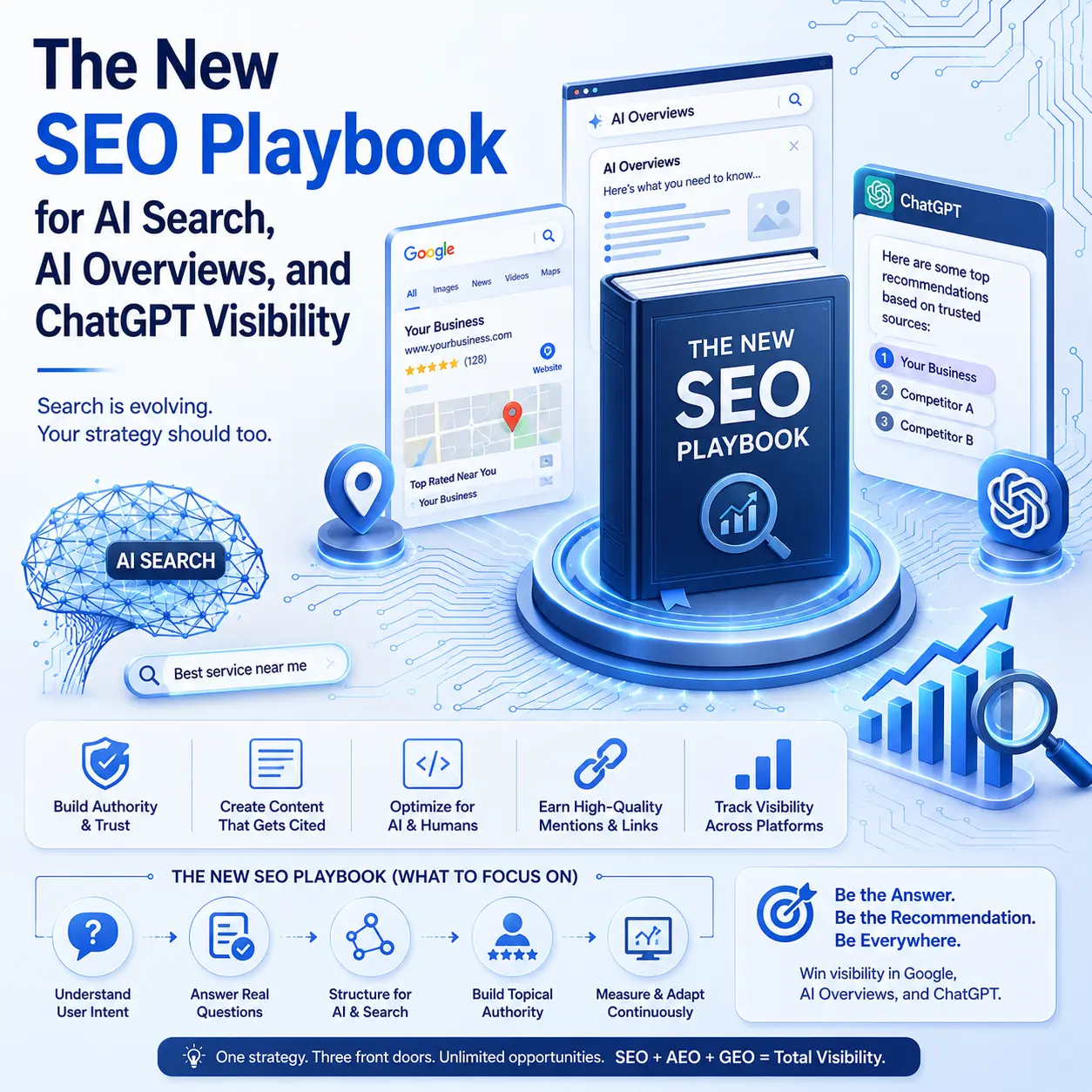
Search engine optimization is changing because the search experience itself is changing.
Customers still use Google to find businesses, compare services, read reviews, and visit websites. However, they are no longer limited to scrolling through a traditional list of search results. They can receive an AI Overview above the organic listings, continue a detailed conversation in Google AI Mode, ask ChatGPT for recommendations, or use another AI assistant to compare several options.
A person searching for an AI receptionist may no longer type only “AI receptionist for small business.” The person may ask:
“What is the best way for a service business to answer calls after hours, qualify leads, and schedule appointments without hiring another employee?”
That question contains several needs. The search system must understand the problem, identify relevant solutions, compare options, and assemble a useful answer. The businesses included in that answer may not be selected because they repeated one keyword more often than their competitors. They may be selected because their websites clearly explain the service, answer related questions, provide verifiable information, and make their expertise easy to understand.
This does not mean traditional SEO is dead. Google states that its generative search features remain connected to its core search ranking and quality systems. Pages still need to be crawlable, indexed, relevant, and eligible to appear in regular search results before they can be considered for supporting links in AI Overviews and AI Mode.
The new SEO playbook builds on those fundamentals. It expands the goal from ranking for keywords to becoming a useful source for traditional search results, direct answers, generative responses, local recommendations, and AI-assisted customer journeys.
What Has Changed About Search?
Traditional SEO often followed a fairly predictable process.
A business identified a valuable keyword, created a page around that keyword, optimized the title and headings, built internal and external links, and monitored where the page ranked.
That process still matters, but modern searches are becoming longer, more conversational, and more specific.
A customer may ask Google or ChatGPT to compare several services, account for a particular business type, explain costs, identify risks, and recommend the next step within one prompt.
Google explains that AI Overviews and AI Mode may use a process called query fan-out. The system generates multiple related searches across different subtopics and information sources, retrieves useful pages, and uses that material to create a broader response. This allows one detailed question to trigger several behind-the-scenes searches.
For example, a business owner might ask:
“Should I use an AI receptionist or a traditional answering service for my plumbing company?”
The system may look for information related to:
- AI receptionist features
- Answering service pricing
- Appointment scheduling
- Call qualification
- After-hours availability
- Home-service business use cases
- Customer privacy
- Software integrations
A company may have a strong page about AI receptionists, but it could still miss the opportunity if the page does not explain comparisons, limitations, costs, integrations, or industry-specific applications.
Modern search visibility depends on covering the complete decision, not just matching a short phrase.
What Has Not Changed About SEO?
The basic requirements of search visibility remain important.
Search engines still need to access the website. Important pages still need internal links. Content still needs a clear purpose. The website still needs to work well on mobile devices. Business information still needs to be accurate. Pages still need to satisfy the person who visits them.
Google’s current guidance is direct: the foundational practices used for traditional SEO continue to apply to AI Overviews and AI Mode. Google does not require a separate type of page, a special AI schema, or a different version of the website for generative search.
This is important because businesses are being presented with a growing number of supposed AI search shortcuts.
Some companies are told that they need to rewrite every page into tiny content blocks. Others are told that adding one file or one schema type will make their website appear in AI answers. Some are encouraged to create hundreds of pages targeting every possible variation of a question.
Those tactics can distract from the work that matters.
A website still needs strong service pages, useful supporting content, clear business information, sound technical SEO, legitimate public references, and a practical conversion system.
The new playbook does not replace SEO. It updates how SEO is planned and measured.
Step 1: Make Sure Your Website Is Eligible to Be Found
Before improving AI visibility, confirm that search systems can access the website.
A page cannot support an AI-generated response if the system cannot crawl, render, understand, or index it.
The technical review should begin with the website’s most important pages. These usually include the homepage, major service pages, location pages, contact page, about page, blog articles, case studies, and frequently asked questions.
Check whether these pages are included in the XML sitemap and linked through the website’s navigation or relevant content. A page that exists but has no internal links may be difficult for search engines and visitors to discover.
Review the robots.txt file, noindex directives, canonical tags, redirects, server responses, and security settings. A robots.txt rule may appear correct while a firewall, content delivery network, or security plugin continues to block legitimate crawlers.
Google specifically recommends allowing crawling through robots.txt and hosting infrastructure, making content discoverable through internal links, providing important information in text, and keeping structured data consistent with the visible page.
Technical eligibility is not a ranking strategy by itself. It is the entry requirement for every other part of the strategy.
Step 2: Build Pages Around Services and Customer Decisions
Many business websites are not organized around the way customers make decisions.
A company may list ten services in one short homepage section without providing a dedicated page for each major offer. This may be enough for a visitor who already knows the company, but it provides limited material for search engines and AI systems.
Each important service should have a focused page that explains:
- What the service is
- Which problem it solves
- Who it is designed for
- How the process works
- What is included
- Which outcomes the customer can reasonably expect
- How it differs from alternatives
- What the customer should do next
For Perfect Business AI, a page about an AI receptionist should not rely on a broad statement such as “Never miss another call.”
The page should explain how calls are handled, which questions the system can answer, whether it can schedule appointments, how leads are qualified, when calls are transferred, which businesses benefit most, and how the system connects with the company’s existing workflow.
This gives traditional search engines a complete service page to rank. It gives answer engines clear responses to extract. It also gives generative systems enough context to understand when the service may be relevant to a user’s request.
Step 3: Create Topic Clusters Instead of Isolated Blog Posts
One blog article rarely establishes complete coverage of a subject.
A stronger strategy connects a main service page with supporting content that addresses the customer’s questions before, during, and after the buying decision.
An AI receptionist content cluster could include articles about:
- AI receptionist versus answering service
- How missed-call text-back works
- AI receptionist pricing factors
- Appointment scheduling with AI
- After-hours call handling
- AI receptionist use cases for home-service businesses
- Common implementation mistakes
- Questions to ask an AI receptionist provider
These articles should link naturally to the main service page and to one another where relevant.
The purpose is not to publish every keyword variation as a separate article. Google warns that producing large numbers of pages primarily to manipulate rankings or generative answers is not an effective long-term approach and may violate its scaled content abuse policies.
A good topic cluster covers distinct customer needs. It does not create several thin pages that say nearly the same thing.
Step 4: Answer Important Questions Early
AI-assisted search rewards clarity because the system must identify useful passages within a page.
That does not mean every article should be reduced to one-sentence answers. It means the reader should not have to work through a long introduction before receiving a useful response.
Under a heading such as “What Is an AI Receptionist?” begin with a direct explanation.
An AI receptionist is a software-based system that can answer calls or messages, respond to common questions, collect lead information, schedule appointments, and route customers according to a business’s rules.
The paragraphs that follow can explain how the system works, which channels it supports, where human involvement is still needed, and how the service is configured.
This answer-first structure works well because it serves two audiences.
The customer receives an immediate response.
The search system receives a clear passage that can be understood, retrieved, or summarized.
The page should still provide depth. A short answer without supporting details may be useful for a basic definition but insufficient for a buying decision.
Step 5: Publish Information Competitors Cannot Easily Copy
Generic content is becoming easier to produce.
An AI writing tool can create a basic article about website design, customer reviews, lead generation, or business automation in seconds. If a company publishes the same advice found across hundreds of other sites, there is little reason for a search system to prefer that page.
Google’s current guidance emphasizes useful, original, non-commodity content. It recommends bringing a distinct point of view, firsthand experience, and information that goes beyond repeating what is already available.
For a service business, original content can come from daily operations.
A company could explain the exact questions customers ask before purchasing a service. It could document a common implementation problem and show how the team corrected it. It could compare two approaches based on actual client needs. It could publish screenshots, workflow examples, before-and-after measurements, or a detailed case study.
A generic article might say:
“Responding to leads quickly can improve conversions.”
A stronger article might explain how a missed-call text-back workflow is triggered, what the first message says, which questions are asked, when the conversation is assigned to a staff member, and how the company measures response time and booked appointments.
Specific information demonstrates practical knowledge. It also gives AI systems material that may not appear on competing pages.
Step 6: Make Your Business Identity Clear
AI visibility is not only about individual pages. It is also about whether search systems can identify the business accurately.
The company name, website address, phone number, location, service area, services, leadership, and public profiles should be consistent across the website.
The about page should clearly explain who the company is, what it does, who it serves, and where it operates. Important content should identify the writer or reviewer when the person’s experience is relevant to the topic.
The contact page should provide complete information rather than relying only on a form.
The website should connect to official social profiles, business directories, review profiles, and other legitimate public references.
This consistency helps search systems distinguish the company from similarly named businesses. It also reduces the chance that an AI-generated response will use outdated, incomplete, or conflicting information.
Step 7: Strengthen Local Search Information
Local searches are especially important for companies that serve specific cities or service areas.
A person may ask:
“Who provides emergency electrical service near Queen Creek?”
“Which chiropractor in Woodstock works with veterans?”
“Find a business automation company that serves Arizona businesses.”
The system may use the company’s website, Google Business Profile, reviews, directories, service pages, and other public information to develop an answer.
Google recommends keeping Business Profile information current because local business details may be included in both traditional search results and generative responses.
Businesses should verify their categories, hours, services, phone number, website, address or service area, photos, and business description.
Reviews also matter because they provide public evidence of customer experiences. A steady pattern of detailed, authentic reviews gives potential customers more information than a simple star rating.
The website should support those local signals with relevant service-area content. A location page should explain how the business serves that community rather than changing only the city name across several otherwise identical pages.
Step 8: Use Structured Data Correctly
Structured data can help search engines interpret information about a business, article, service, product, event, video, or page structure.
Common schema types may include:
- Organization
- LocalBusiness
- Service
- Article
- BreadcrumbList
- Person
- VideoObject
- Product, when appropriate
The markup must match the visible content.
A business should not add services, reviews, ratings, prices, addresses, or claims to its schema if those details are not supported on the page.
Structured data can support rich-result eligibility and improve clarity, but it should not be treated as a guaranteed AI citation method. Google states that there is no special schema required for AI Overviews or AI Mode and warns businesses against overfocusing on structured data as an AI visibility shortcut.
Schema is a supporting layer. It cannot replace a complete service page, accurate business information, or useful content.
Step 9: Add Useful Images and Videos
Modern search results are not limited to written links.
Google’s generative search features can include relevant images and videos, creating additional opportunities for a business to appear. Google recommends supporting written content with high-quality visual material when it benefits the user.
A business could add:
- A service demonstration
- A short expert explanation
- A process diagram
- An original comparison chart
- Before-and-after examples
- Screenshots of a workflow
- A customer education video
Visual content should add information. Decorative stock images may make a page look better, but they rarely explain the service.
Images should use descriptive file names and alternative text. Videos should have clear titles, descriptions, transcripts, and visible supporting information on the page.
A video should not contain important details that are unavailable anywhere in written form. Some users will not watch it, and search systems may understand the page more reliably when the main information is also available as text.
Step 10: Prepare Your Website for ChatGPT Search
ChatGPT visibility requires attention to OpenAI’s search crawler.
OpenAI identifies OAI-SearchBot as the crawler used to surface websites in ChatGPT search features. Websites that opt out of OAI-SearchBot will not be shown as sources in ChatGPT search answers, although they may still appear as basic navigational links in some circumstances.
A website that wants to allow ChatGPT search access can use the following robots.txt rule:
User-agent: OAI-SearchBot
Allow: /
Allowing the crawler does not guarantee a citation or recommendation. It removes one access barrier.
The business should also confirm that its firewall, hosting provider, CDN, or security service allows requests from OpenAI’s published IP ranges. OpenAI notes that robots.txt changes may take approximately 24 hours to be reflected by its systems.
OAI-SearchBot and GPTBot have separate controls.
OAI-SearchBot relates to search visibility. GPTBot relates to content that may be used to improve OpenAI’s generative models. A website can allow OAI-SearchBot while disallowing GPTBot because the settings operate independently.
This distinction allows a business to make an informed choice about search visibility and model-training access rather than treating all AI crawlers as the same.
Step 11: Do Not Treat an llms.txt File as a Google Ranking Factor
The llms.txt concept has received attention as a possible way to provide AI systems with a simplified description of a website’s content.
A business may choose to experiment with the file for platforms or systems that decide to use it. However, it should not be positioned as a guaranteed visibility method.
Google states that it does not use llms.txt or other special AI text files for Google Search, including its generative AI features. According to Google, creating the file neither improves nor harms a site’s visibility in Google Search.
This does not mean every possible use of the file is worthless. It means the business should keep priorities in the correct order.
Fix indexing problems first.
Improve important service pages.
Publish original information.
Strengthen local and public business signals.
Allow the appropriate crawlers.
Use experimental files only after the essential work has been completed.
Step 12: Build Public Confirmation Outside Your Website
Search and AI systems may evaluate information from more than the company’s own pages.
They may encounter the business through review platforms, directories, news articles, social profiles, professional associations, videos, interviews, community organizations, and relevant industry websites.
These sources can help confirm what the company does and whether its public identity is consistent.
A business should focus on earning genuine references rather than creating artificial mentions.
Useful opportunities may include contributing expert information to an industry publication, participating in a local organization, publishing a detailed case study with a client’s permission, appearing on a relevant podcast, or maintaining accurate profiles on established platforms.
Google advises against pursuing inauthentic mentions as an AI visibility tactic. Its generative features continue to rely on quality and spam-detection systems.
The goal is not to place the company name on as many websites as possible. The goal is to build a public record that accurately supports the company’s claims.
Step 13: Optimize for Conversion After the AI Referral
Visibility is not the final result.
A customer may discover a business through an AI Overview or ChatGPT answer and then visit the website. That visitor may already know the basic facts because the AI response summarized them.
The landing page must help the visitor take the next step.
A strong service page should provide a clear call to action, visible contact options, relevant proof, common questions, and a simple explanation of what happens after the visitor reaches out.
The website should also account for customers who are not ready to call.
Web chat, text messaging, appointment scheduling, downloadable resources, and clear inquiry forms can provide lower-friction options.
Fast follow-up is especially important. The company may invest heavily in SEO and AI visibility, only to lose the lead because nobody responds to the form submission or missed call.
The new SEO playbook connects discovery with customer communication, follow-up, booking, and measurement.
How to Measure AI Search Visibility
Traditional SEO reports often focus on rankings, organic traffic, impressions, and clicks.
Those metrics remain useful, but AI search requires a broader scorecard.
Google has introduced a Generative AI performance report in Search Console for a subset of website owners. The report includes impressions from AI Overviews and AI Mode and can show which pages receive visibility, as well as performance by country, date, and device. Google notes that the feature is still being rolled out, so it may not yet appear for every Search Console property.
Google is also rolling out a Search generative AI control in Search Console. The control allows eligible property owners to include or exclude their site’s links and content from Google’s generative search features. Excluding a site prevents its content from appearing as links or grounding material in the covered experiences.
For ChatGPT and other AI platforms, businesses should review analytics referral data, landing pages, form submissions, call records, and CRM sources.
Not every visit will be labeled perfectly. A customer may discover the company through an AI answer and later return through a branded Google search, direct visit, or saved link.
Sales teams can improve attribution by asking new customers how they found the company and including AI search options in lead-source tracking.
A practical AI visibility report should monitor:
- Generative search impressions where platform data is available
- AI referral traffic
- Pages receiving AI referrals
- Brand mentions in relevant prompts
- Accuracy of generated descriptions
- Calls, forms, appointments, and sales connected to those visits
- Changes in branded search demand
The objective is not to appear in random AI answers. It is to be visible for questions connected to real customer needs and business revenue.
A 90-Day AI Search SEO Plan
Days 1–30: Repair the Foundation
Start with crawling, indexing, security settings, internal links, sitemaps, canonical URLs, mobile usability, and page performance.
Review OAI-SearchBot access and verify that hosting or security systems are not blocking it.
Identify the services that generate the most revenue and confirm that each has a complete, indexable page.
Audit company information across the website, Google Business Profile, directories, social profiles, and schema.
Days 31–60: Improve Content Coverage
Expand major service pages with clear explanations, customer questions, use cases, comparisons, limitations, processes, and next steps.
Build a supporting content plan based on actual sales calls, customer emails, search queries, and consultation questions.
Update weak articles rather than publishing new material simply to increase page count.
Add original examples, screenshots, diagrams, videos, case studies, or process details.
Days 61–90: Strengthen Authority and Measurement
Correct inaccurate directory profiles and request genuine reviews from customers.
Look for legitimate opportunities to publish expert information or earn relevant industry mentions.
Configure analytics and CRM lead-source tracking for AI referrals.
Create a repeatable set of important customer prompts and review how the business appears across AI search platforms.
Compare visibility with conversions so the team knows which work is producing business value.
Common AI Search SEO Mistakes
Creating Large Amounts of Generic Content
More pages do not automatically create greater authority.
Publishing dozens of articles that restate common information can weaken a website’s overall quality and make maintenance harder.
Every page should serve a distinct customer need.
Writing Only for AI Systems
Content should remain natural and useful for people.
Google states that websites do not need to rewrite content into a special style for generative search or divide every subject into tiny fragments. Its systems can understand synonyms, context, and related meanings.
Depending on Schema Alone
Schema can support understanding, but it cannot compensate for thin or inaccurate visible content.
Blocking Important Crawlers
An incorrect robots.txt rule, firewall setting, or security configuration can remove a website from consideration before content quality is evaluated.
Measuring Only Rankings
A page may lose a traditional ranking position while gaining visibility in an AI feature. Another page may receive more impressions but fewer clicks.
Track leads and revenue alongside rankings.
Ignoring the Customer Experience
Visibility has limited value if the website is confusing, the contact form is broken, the phone is unanswered, or the company does not follow up.
How Perfect Business AI Supports the New SEO Playbook
Perfect Business AI combines search visibility with the systems needed to convert attention into customer activity.
The company’s website lists AI SEO optimization, AI-optimized websites, AI directory visibility, content marketing, managed WordPress hosting, review management, AI receptionists, web chat, smart texting, CRM tools, email marketing, and related growth services.
These services support different stages of the customer journey.
Search optimization helps the business become discoverable.
A clear, technically sound website helps search engines and AI systems understand the company.
Content answers customer questions.
Directory and reputation management strengthen public business information.
Web chat, smart texting, and AI receptionists help respond to inquiries.
CRM and automated follow-up help keep potential customers from being forgotten.
The strongest strategy does not stop after earning an impression or citation. It connects search visibility with response, booking, follow-up, reputation, and measurable growth.
Frequently Asked Questions About AI Search SEO
Is Traditional SEO Still Important for AI Overviews?
Yes.
Google’s AI search features remain connected to its regular search index, ranking systems, technical requirements, and content-quality systems. A page generally needs to be indexed and eligible to appear with a search snippet before it can be considered as a supporting link in AI Overviews or AI Mode.
How Can a Website Appear in Google AI Overviews?
There is no guaranteed submission process or special markup.
Businesses should focus on crawlability, indexing, useful content, clear page structure, accurate information, strong internal links, relevant images or videos, and current business details. Meeting those requirements creates eligibility, but it does not guarantee inclusion.
How Can a Business Improve ChatGPT Visibility?
Allow OAI-SearchBot, make sure security systems are not blocking OpenAI’s published crawler traffic, and publish accessible information that clearly explains the business and its services.
Crawler access is necessary for normal search inclusion, but it does not guarantee that ChatGPT will cite or recommend the business.
Does a Website Need Special AI Schema?
No.
Google says there is no special schema required for AI Overviews or AI Mode. Businesses should continue using accurate structured data that matches visible page content and supports applicable traditional search features.
Does llms.txt Improve Google AI Visibility?
Google says it does not use llms.txt for Google Search, including its generative AI features. The file does not improve or damage Google rankings. Businesses may experiment with it for other systems, but it should not replace core SEO work.
Should Every Article Be Written as a List of Questions?
No.
Question-based headings are useful when they match customer needs, but the page should still read naturally. Some topics work better as tutorials, comparisons, case studies, explanations, or service pages.
Can a Business Appear in AI Results Without Ranking First Organically?
It is possible because generative systems can retrieve and compare several sources. However, strong technical SEO, relevance, content quality, and authority still improve the likelihood that a page will be discovered and considered.
How Long Does AI Search Optimization Take?
There is no fixed timeline.
Results depend on the website’s current condition, crawling frequency, competition, authority, content quality, local signals, and the types of questions customers ask.
A business should treat AI visibility as an ongoing part of search strategy rather than a one-time website update.
Conclusion
The new SEO playbook is not based on abandoning Google rankings or chasing an AI search shortcut.
It begins with the same foundation that has always supported search visibility: accessible pages, clear website structure, relevant content, accurate information, useful internal links, and a strong customer experience.
The difference is that the content must now support more ways of searching.
Customers may type a short keyword, ask a detailed question, request a comparison, read an AI Overview, continue through Google AI Mode, or ask ChatGPT for a recommendation.
Businesses need service pages that explain complete solutions, supporting content that addresses real decisions, original information based on practical experience, consistent public business details, appropriate crawler access, and a system for measuring both visibility and conversions.
The goal is no longer limited to ranking number one for a single keyword.
The goal is to become one of the most useful, understandable, and verifiable sources wherever customers search—and then provide a clear path from discovery to conversation, appointment, and sale.