
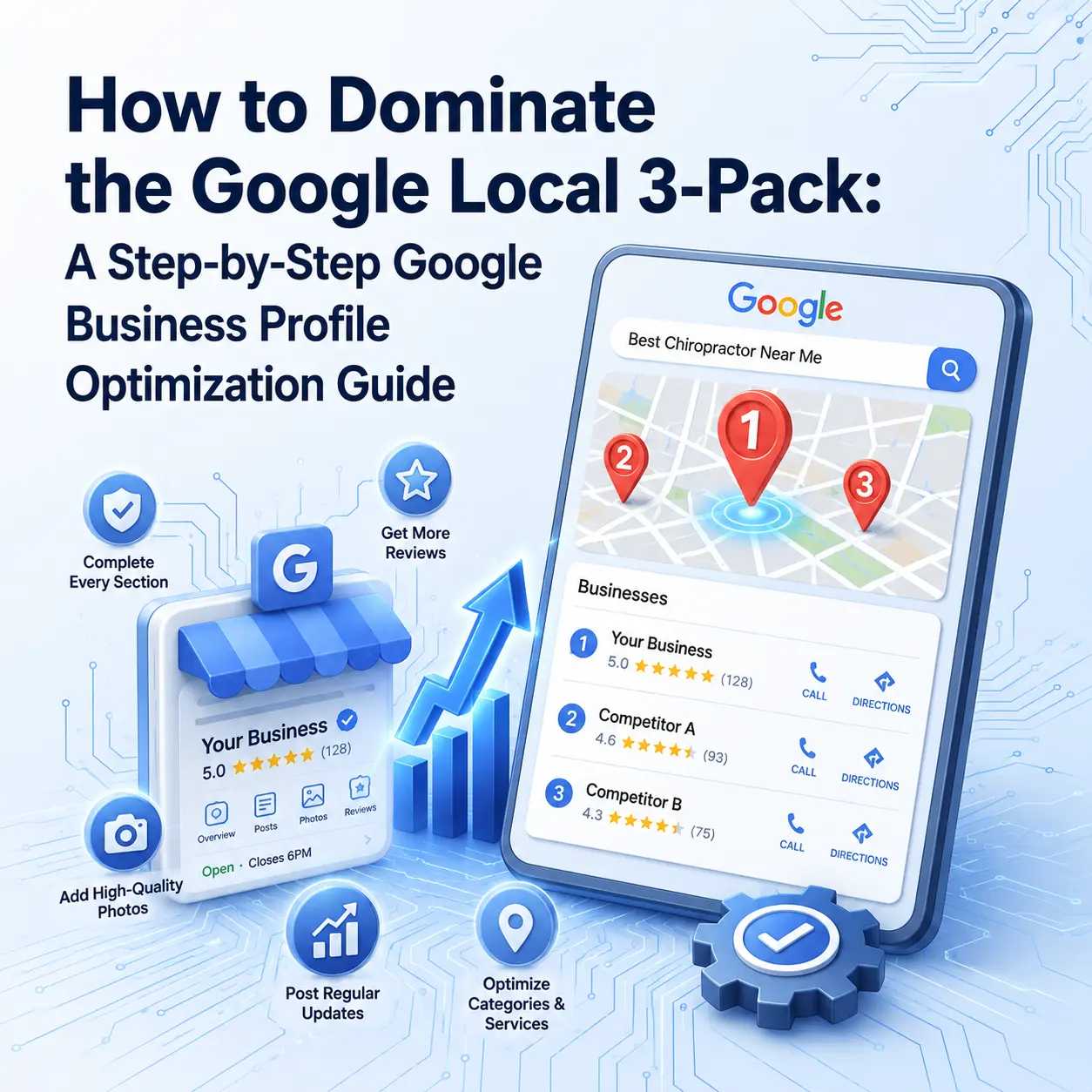
If you’ve ever searched “coffee shop near me” or “emergency plumber open now,” you already know what the Local 3-Pack is — those three map listings that sit right at the top of Google before any organic results. For local businesses, landing in that 3-Pack is one of the highest-value positions in digital marketing. It drives calls, foot traffic, and website visits from people who are actively ready to buy.
The good news? Getting there isn’t reserved for businesses with massive marketing budgets. It comes down to one thing: treating your Google Business Profile (GBP) as a living, active extension of your business — not a digital form you filled out once and forgot about. Whether you run a tax consultancy, a neighborhood café, or a mobile plumbing operation, this guide gives you a clear, actionable roadmap to optimize your profile and compete for that top-tier visibility.
Why Your Google Business Profile Is the Center of Your Local SEO Strategy
Before diving into tactics, it’s worth understanding why your GBP carries so much weight. Google’s local ranking algorithm considers three core signals: relevance (how well your profile matches a search), distance (proximity to the searcher), and prominence (how well-established and trusted your business appears across the web). Your GBP directly influences all three.
Leaving your profile incomplete or outdated sends Google a quiet but damaging signal — that your business isn’t active, isn’t credible, or simply can’t be verified. On the other hand, a well-maintained, consistently updated profile tells Google’s algorithm that you’re a legitimate, trusted option worth surfacing to local searchers. That distinction alone separates businesses that dominate the 3-Pack from those that never appear in it at all.
Keep Your Business Name Clean and Compliant
Here’s a mistake that gets businesses suspended more often than most people realize: adding keywords to your business name field. If your legal business name is “Smith & Sons Plumbing,” listing yourself as “Smith & Sons Plumbing — Best Cheap Plumber Fast Fix Emergency Repair Phoenix” is a direct violation of Google’s guidelines.
Google’s AI-driven fraud detection systems have become remarkably accurate at catching keyword-stuffed names, and the penalty is a profile suspension that can take weeks to resolve. Your business name in your GBP should match exactly what appears on your street signage, your website, and your legal documents — nothing more. Keywords belong in your services list, your business description, and your review responses, not in your name field.
NAP Consistency: The Foundation Google Builds Trust On
NAP stands for Name, Address, and Phone number. It sounds basic, but inconsistent NAP data is one of the most common reasons strong businesses lose local rankings.
Google constantly cross-references your profile against dozens of other online sources — your website footer, your Facebook page, Yelp, YellowPages, local directories, and more. If your address appears as “123 Main Street, Suite B” in one place and “123 Main Ave” in another, Google can’t confidently verify your location. That uncertainty erodes trust, and eroded trust translates directly to lower rankings.
The fix is straightforward: build a master list of your core NAP details and audit every online presence against it. Make sure the following match exactly:
- Your Google Business Profile
- Your website footer and contact page
- Social media profiles (Facebook, Instagram, LinkedIn)
- Local business directories (Yelp, YellowPages, Chamber of Commerce listings)
This isn’t a glamorous task, but it’s foundational. Get it right once, and maintain it every time your business details change.
Choosing the Right Categories — Primary Matters Most
Google lets you select one primary category and several secondary ones for your profile. Your primary category carries significant ranking weight, so precision here is non-negotiable.
If you own a pizzeria, selecting “Restaurant” as your primary category is too broad. “Pizza Restaurant” or “Italian Restaurant” puts you in front of searchers with higher purchase intent. The rule of thumb is simple: your primary category should reflect the service or product that generates the largest portion of your revenue.
Secondary categories exist to capture the rest of your service offerings. A pizza restaurant might also add “Caterer” or “Pizza Delivery” as secondary options. What you want to avoid is piling on 10 or 15 loosely related categories, hoping to cast a wider net — that approach dilutes your authority and confuses Google’s relevance signals rather than strengthening them.
The 30-Day Freshness Window: Why Your Photos Are Working Against You
If your GBP photo gallery still features stock images of people in glass conference rooms shaking hands, those photos are actively hurting your profile’s performance. Google’s 2026 search landscape rewards authenticity, and its systems can detect the difference between a real, location-tagged photo taken on a business owner’s smartphone and a purchased stock image.
Beyond the type of photos you upload, the frequency matters just as much. Letting your profile go completely inactive for more than 30 days causes a measurable dip in local visibility. Google interprets that silence as a sign that the business may be closed or disengaged.
What to Upload Every Month
This doesn’t have to be a professional photo shoot. Consistency beats production quality here. Focus on:
- Exterior “Proof of Life” shots — A clean, well-lit photo of your storefront or branded vehicle, ideally showing current signage
- Behind-the-scenes action — Your actual team at work: cooking, styling, repairing, building
- Before-and-after results — Particularly powerful for service businesses in landscaping, remodeling, detailing, or cleaning
Smartphone photos are not just acceptable — they’re often preferable. The GPS metadata embedded in smartphone photos confirms to Google that the image was taken at your actual physical location, which adds a layer of authenticity that stock images simply cannot replicate.
Reviews Are a Campaign, Not an Afterthought
Most business owners understand that reviews matter. Fewer understand that the timing and pace of reviews now matter just as much as the total count. Google’s local algorithm places heavy emphasis on recency and velocity — a steady flow of two or three fresh reviews per week will outperform a business that collected 500 reviews two years ago and hasn’t received one since.
That shift changes how you should approach your review strategy. It’s no longer enough to ask for reviews occasionally or when you happen to remember. You need to build the request into your standard workflow so it happens consistently without relying on memory.
Building a Review System That Works
The most effective approach has two parts. First, automate the ask. Send a follow-up text message or email within 24 hours of completing a job, delivering a product, or finishing a service appointment. That window matters — customers are most motivated to leave a review while the positive experience is still fresh.
Second, respond to every review within 48 hours, positive or negative. When replying to a positive review, work in natural language that reflects your actual services and location (for example, “Thanks so much for choosing us for your laptop repair in Denver — we appreciate the kind words!”). That response isn’t just courtesy; it becomes indexed content that reinforces your local relevance to Google.
Negative reviews deserve just as much attention. A calm, professional response to criticism does something counterintuitive — it actually builds trust with potential customers who read it. People don’t expect perfection. They expect accountability. Showing that you handle problems with maturity signals to both customers and Google’s algorithm that you operate a credible, reliable business.
Stop Leaving Your Dashboard Half-Empty
Your GBP dashboard has several structural sections that many business owners either skip or fill in carelessly. Google will attempt to auto-populate these fields using web scraping if you leave them blank, and the results are rarely accurate or flattering.
The Business Description
You have 750 characters. Use them like a human being explaining their business to a neighbor, not like someone stuffing a webpage with search terms. Talk about your mission, mention your service area, and touch on what makes your business worth choosing. Natural, readable language performs better than keyword-dense copy that reads like a list.
Services and Products
This section feeds directly into how Google interprets and surfaces your business in AI-powered conversational searches. Break down your core offerings, add clear descriptions, and include pricing where it makes sense for your business model. The more complete this section is, the more context Google has to match you with relevant searches.
Attributes
Attributes are the checkboxes in your dashboard that flag specific qualities about your business — things like “Women-led,” “Wheelchair accessible,” “LGBTQ+ friendly,” or “Outdoor seating.” These function as search filters, and many users specifically filter by them when searching on Google Maps. Check off every attribute that genuinely applies to your business.
Make Profile Optimization a Regular Habit
One of the biggest misconceptions about Google Business Profile optimization is that it’s a one-time setup project. Businesses that treat it that way consistently fall behind competitors who maintain their profiles actively.
The time investment doesn’t need to be significant. Spending 15 minutes every two weeks — uploading a couple of fresh photos, verifying your holiday hours are accurate, and responding to your latest reviews — is enough to maintain strong visibility signals. That small, consistent effort compounds over time and puts real distance between you and competitors who set their profile up once and never look at it again.
Conclusion
Ranking in Google’s Local 3-Pack is achievable for any local business, regardless of size or marketing budget. The businesses that consistently show up there aren’t necessarily the biggest or the most established — they’re the ones that take their Google Business Profile seriously and maintain it as an active, accurate, and engaging reflection of what they actually offer.
Start with your business name and NAP consistency, nail down your primary category, and get into the habit of uploading real photos and collecting fresh reviews on a regular schedule. Fill out every section of your dashboard with honest, human-written content, and respond to your reviews like the professional you are.
If you want help building a system around this — automating your review requests, tracking your local rankings, or auditing your profile for gaps — Perfect Business AI has the tools and expertise to make that process straightforward. Local search isn’t slowing down, and neither should your effort to compete in it.