
Small businesses have always faced a content marketing challenge: they need to stay visible, educate potential customers, build trust, and generate leads without the large marketing teams available to national brands.
Artificial intelligence is changing that equation.
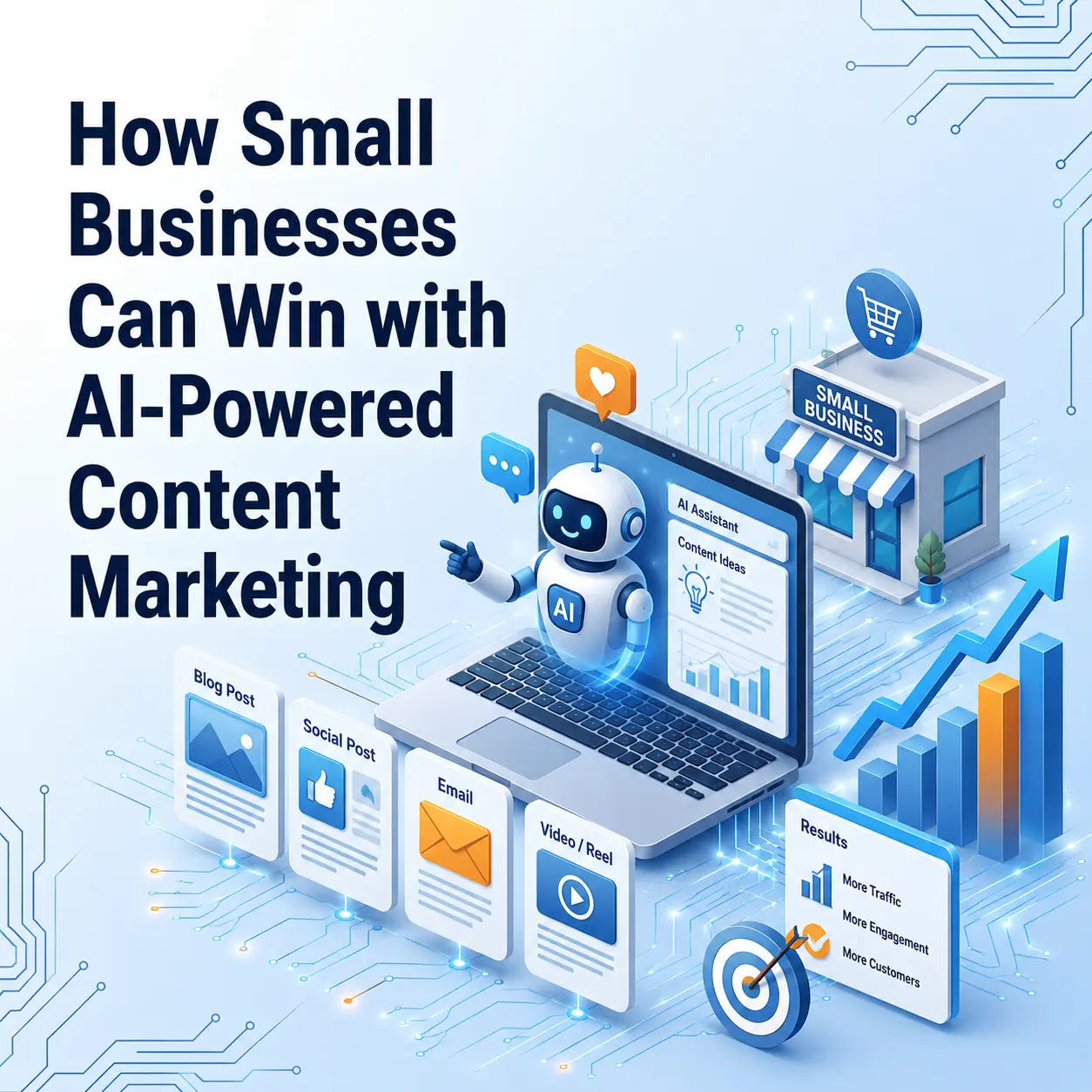
AI-powered content marketing gives small businesses a practical way to research topics, organize ideas, create first drafts, repurpose existing material, personalize communication, and measure results. A local business can now operate a more consistent content program without hiring a separate employee for blogging, email, social media, video production, and campaign analysis.
However, access to AI does not automatically produce effective marketing. Publishing more content is not the same as creating useful content. Businesses that generate hundreds of generic articles, repeat information already available online, or publish inaccurate material may damage their credibility instead of improving it.
The real opportunity is to combine AI efficiency with human knowledge, customer experience, and a clear marketing system.
For small businesses, winning with AI-powered content marketing means creating the right content for the right audience, distributing it through the right channels, and connecting each piece to a measurable business goal.
What Is AI-Powered Content Marketing?
AI-powered content marketing is the use of artificial intelligence to support the planning, creation, distribution, personalization, and analysis of marketing content.
The important word is “support.”
AI should strengthen the business’s marketing process rather than replace the knowledge of the owner, employees, subject-matter experts, or customers. A roofing contractor knows which storm damage signs homeowners tend to overlook. A chiropractor understands the questions patients ask before their first appointment. An insurance professional knows which coverage details regularly confuse policyholders.
That firsthand knowledge is what makes content credible. AI helps turn that knowledge into useful articles, emails, videos, social posts, frequently asked questions, lead-nurturing messages, and sales materials.
For example, a business owner may record a ten-minute voice note explaining a common customer problem. An AI-supported workflow can help organize that explanation into a blog article, extract several social media posts, create an email newsletter, propose a short video script, and identify related questions for future content.
The business still supplies the experience and verifies the details. AI reduces the repetitive work required to package and distribute that expertise.
Why AI Gives Small Businesses a Real Competitive Opportunity
Large companies usually have more money, staff, software, and advertising reach. Small businesses have a different advantage: they are closer to their customers.
They hear real questions during sales calls. They see which concerns delay a purchase. They know how local conditions affect the customer’s problem. They can often explain a topic in more practical language than a large publisher that is writing for a national audience.
AI makes it easier to turn those customer insights into a consistent content library.
A small business no longer needs to choose between writing one blog article or posting on social media. One strong source piece can support several channels. An educational article can become a video, an email sequence, a downloadable checklist, a sales follow-up message, and a collection of frequently asked questions.
This allows smaller companies to compete based on relevance rather than volume.
The goal is not to publish more than every competitor. The goal is to become the clearest and most trustworthy answer for the specific problems customers are trying to solve.
How AI Can Improve the Content Marketing Process
AI can support almost every stage of content marketing, but it works best when each task is connected to a defined strategy.
Faster Customer and Topic Research
Many businesses begin content planning by guessing what people want to read. AI can help organize actual customer language from sales notes, support emails, website searches, customer reviews, chat transcripts, and frequently asked questions.
A business can use this information to identify patterns such as:
- Questions customers repeatedly ask before buying
- Problems that create urgency
- Misunderstandings that delay decisions
- Services customers do not know the business offers
- Comparisons customers make between competing solutions
- Concerns about cost, timing, safety, quality, or reliability
This produces a stronger content plan than selecting topics based only on search volume.
Keyword research still matters, but search phrases should be connected to real customer needs. A keyword can bring website traffic, but a customer-focused answer is what builds trust and generates an inquiry.
More Consistent Content Planning
Many small businesses publish content only when someone has extra time. That usually leads to several posts in one month followed by a long period of inactivity.
AI can help build an organized editorial calendar based on services, seasonal demand, customer questions, geographic markets, and stages of the buying journey.
For example, an HVAC company could build content around maintenance, emergency repairs, replacement decisions, energy efficiency, indoor air quality, financing, and seasonal preparation. AI can then help divide those themes into informational articles, comparison pages, checklists, videos, and email campaigns.
The calendar should still reflect business priorities. When a company wants to increase a specific service line, enter a new market, or prepare for seasonal demand, the content plan should support that objective.
Efficient First-Draft Creation
Creating a first draft is one of the most time-consuming parts of content production. AI can turn outlines, interviews, voice notes, service details, and customer questions into an organized starting point.
That does not mean the first draft should be published without review.
A strong workflow gives the AI specific source material and instructions. The prompt may include the target customer, service area, desired action, important facts, prohibited claims, tone, examples, and internal pages that should be referenced.
The draft then needs human editing for accuracy, clarity, brand voice, local relevance, and originality.
AI-generated content becomes more valuable when the business adds details that a general tool would not know. These details may include what the team sees in the field, how the service process works, common mistakes, realistic timelines, regional conditions, customer examples, and recommendations based on experience.
Content Repurposing Across Channels
A business should not have to start from a blank page for every marketing channel.
A detailed blog article can become several smaller content assets. The article’s introduction may become an email. A comparison section may become a short video. A checklist may become a social media carousel. Common questions may become individual Google Business Profile posts or website FAQs.
Repurposing saves time while reinforcing the business’s core message.
AI can help adjust the same idea for different platforms. A LinkedIn post may require a professional and analytical tone, while a Facebook post may be more conversational. An email should guide the reader toward a next step, while a short video script needs a strong opening and simple spoken language.
Repurposing should not mean copying the same wording everywhere. Each format should fit the expectations of the audience and the channel.
Better Email and Lead-Nurturing Content
Content marketing should continue after someone visits the website or submits a form.
AI can help businesses create email and text-message sequences based on the lead’s interest, service type, or stage in the buying process. A person who downloads a guide may need educational follow-up. A customer who requests an estimate may need reminders, answers to common objections, and information about what happens next.
This creates a more helpful experience than sending the same promotional email to every contact.
Perfect Business AI combines content marketing with services such as email marketing, social media marketing, customer relationship management, website chat, SEO, and automated follow-up. Bringing these tools into one connected system allows content to support customer acquisition, nurturing, scheduling, and retention rather than operating as an isolated activity.
Improved Content Analysis
AI can help summarize performance data and identify patterns that may be difficult to notice in a spreadsheet.
A business can compare topics, formats, traffic sources, calls to action, conversion rates, and customer segments. It can identify which articles generate qualified inquiries, which emails lead to appointments, and which videos hold attention.
However, AI should not make marketing decisions without context. A page with low traffic may still generate valuable leads. A social post with high engagement may produce no sales. A blog article may assist a conversion even when it is not the final page viewed before a customer contacts the business.
The business must decide which outcomes matter.
Why Human Expertise Still Determines Content Quality
AI can produce clear sentences, but it does not automatically understand a company’s customers, standards, limitations, or reputation.
Without human direction, AI-generated content often becomes broad and predictable. It may repeat familiar advice, use unsupported statistics, exaggerate results, or recommend actions that are inappropriate for a specific industry.
Human review is especially important for medical, legal, financial, insurance, safety, and technical content. Incorrect advice in these industries can create real consequences.
Every important piece of content should be reviewed by someone who understands the subject. The reviewer should confirm that the claims are accurate, the examples are realistic, and the recommendations match the business’s actual practices.
The strongest AI-assisted content usually includes elements such as firsthand observations, professional qualifications, specific procedures, original examples, customer questions, local knowledge, and transparent limitations.
Those elements demonstrate experience and expertise. They also give readers a reason to trust the business instead of treating the article as another generic summary.
AI Content and Google Search in 2026
Search visibility remains an important part of content marketing, but the search environment now includes traditional results, AI-generated summaries, conversational search tools, maps, videos, social platforms, and recommendation engines.
Google’s current guidance emphasizes that traditional SEO fundamentals still matter for visibility in generative search. Websites should remain crawlable, technically accessible, clearly organized, and filled with useful, reliable, people-first information. Google also recommends creating unique, expert-led content rather than relying on commodity information that can be found on many other websites.
This means a business does not need a separate strategy built entirely around supposed AI-search tricks.
The foundations remain familiar:
Create content that answers meaningful questions. Make the website easy to crawl and understand. Use descriptive page titles and headings. Connect related pages with internal links. Include accurate business information. Add relevant images and videos. Demonstrate who created or reviewed the content. Keep important pages updated.
Google also warns that generating large numbers of pages without providing additional value may violate its policies against scaled content abuse. AI can be used for research and organization, but accuracy, quality, relevance, and originality remain essential.
The distinction is important. Google is not rejecting content because AI helped create it. The concern is content that exists mainly to manipulate visibility and offers little value to the reader.
How to Build an AI-Powered Content Marketing System
The best results come from creating a repeatable system rather than using AI for occasional writing tasks.
Start With a Specific Business Goal
Every content campaign should support a measurable outcome.
A business may want to increase qualified leads, promote a profitable service, enter a nearby market, improve customer retention, reduce repetitive support questions, or increase appointment bookings.
“Publish more content” is not a complete goal. It describes activity rather than the desired result.
A stronger goal would be to increase estimate requests for commercial electrical services, generate more consultations for retirement planning, or improve bookings for a new patient service.
Once the goal is clear, the business can identify the audience, questions, offers, and distribution channels that support it.
Document the Target Customer
AI produces better content when it is given a detailed audience description.
The description should go beyond age, income, and location. It should explain what the customer is experiencing, what they have already tried, what they fear, what they misunderstand, and what would make them feel confident enough to act.
A homeowner searching for an emergency electrician has different priorities from a property manager comparing maintenance providers. A first-time insurance buyer needs different information from a business owner reviewing several commercial policies.
The more clearly the business understands the customer’s situation, the more relevant the content becomes.
Create Content Pillars
Content pillars are the main subject areas a business wants to be known for.
A dental practice might use preventive care, restorative treatments, cosmetic options, emergency dentistry, patient comfort, and insurance questions. A marketing company might focus on AI automation, websites, SEO, lead generation, customer communication, reputation management, and CRM systems.
Each pillar can support service pages, educational articles, FAQs, videos, emails, social posts, and case studies.
This structure prevents the business from publishing unrelated topics simply because they appear popular. It also makes internal linking easier and helps users explore related information.
Build a Human-Guided Production Workflow
A practical content workflow may include the following steps:
- Select a topic based on customer demand and business goals.
- Collect source information from an expert, employee, customer question, or internal document.
- Use AI to organize the research and create an outline.
- Produce a first draft using detailed instructions and approved sources.
- Review the draft for accuracy, originality, tone, and compliance.
- Add examples, internal links, visuals, and a relevant call to action.
- Publish, distribute, measure, and update the content.
The workflow should identify who is responsible for each stage. A content system becomes unreliable when everyone assumes someone else verified the details.
Create Brand and Accuracy Guidelines
Small businesses should establish written instructions for any employee or vendor using AI.
These guidelines can define the company’s tone, preferred terminology, customer promises, approved service descriptions, geographic markets, legal limitations, citation standards, privacy requirements, and subjects that require expert review.
The guidelines should also explain what information must never be entered into a public AI tool. Sensitive customer records, passwords, confidential contracts, private financial information, and protected health information require appropriate safeguards.
AI speed is useful only when the workflow protects the business and its customers.
The Most Valuable Content Types for Small Businesses
Different content formats serve different business goals. A balanced strategy should include more than blog articles.
Service and Solution Pages
Service pages explain what the company does, who the service is for, what problems it solves, and how the process works.
AI can help improve the structure of these pages, but the final content must reflect the actual service. Generic descriptions make it difficult for customers to understand why they should choose one provider over another.
Strong service pages include practical details, qualifications, service areas, common questions, expectations, proof, and a clear next step.
Frequently Asked Questions
FAQ content is valuable because it reflects the language people use when making decisions.
Questions may come from phone calls, sales conversations, chat messages, reviews, and support tickets. AI can group similar questions and help create clear draft answers.
Each answer should be checked for accuracy and written for a real customer, not merely added to target another keyword.
Case Studies and Customer Stories
Case studies demonstrate how the business approaches real problems.
AI can help organize interview notes into a clear story, but the source information should come from an actual project or customer experience. The business should obtain permission where required and avoid inventing results.
A useful case study explains the situation, challenge, solution, reasoning, outcome, and lessons learned. Even when exact numbers cannot be disclosed, the process can demonstrate experience.
Comparison and Decision Content
Customers frequently compare services, products, methods, providers, and pricing models before contacting a business.
Comparison content helps people understand tradeoffs without forcing an immediate sales pitch. It can explain which option works best under different conditions and when a lower-cost choice may not solve the problem.
Balanced comparisons build more trust than articles that declare the company’s solution is always the best choice.
Original Video and Visual Content
Some topics are easier to understand when demonstrated visually.
A short video can show a process, answer a question, introduce an employee, explain equipment, or walk through a project. Original photos can provide evidence of real work and help customers understand what to expect.
AI can support scripting, editing, captions, summaries, and repurposing. The business’s real people, location, expertise, and work should remain central.
How to Strengthen E-E-A-T in AI-Assisted Content
E-E-A-T refers to experience, expertise, authoritativeness, and trustworthiness. It is particularly important when content affects a person’s health, finances, safety, or major purchasing decisions.
AI does not create E-E-A-T by itself. The business must provide the supporting evidence.
An article becomes more trustworthy when it clearly identifies the author or reviewer, explains relevant qualifications, references reliable sources, describes firsthand experience, and avoids claims that cannot be supported.
Businesses should maintain detailed About and team pages, accurate contact information, real customer feedback, clear service policies, and consistent business information across the web.
Content should also be updated when regulations, technology, prices, services, or recommendations change. An outdated article can continue attracting visitors while giving them inaccurate information.
Transparency matters. When AI plays a substantial role in creating or analyzing content, businesses should consider explaining their review process when that context would help the reader.
Common AI Content Marketing Mistakes
One of the most common mistakes is using AI to increase output before developing a strategy. This results in articles that may be grammatically correct but disconnected from the company’s sales process.
Another mistake is publishing the first draft. AI can state incorrect information confidently, combine unrelated facts, or misunderstand a specialized topic. Every draft requires review.
Businesses also hurt results by targeting the same broad subjects as much larger websites. A local company may struggle to rank for a general topic but perform well with content that combines service expertise, location, customer type, and a specific problem.
Other common problems include repeating the same message across every channel, overusing keywords, creating fake expertise, inventing customer stories, using unsupported statistics, and failing to provide a next step.
AI should make marketing more useful and efficient. It should not make the brand sound less human.
How to Measure AI-Powered Content Marketing
Traffic is useful, but it should not be the only measurement.
A small business should track actions that reflect customer progress. These may include qualified form submissions, phone calls, consultations, appointments, email replies, downloads, repeat visits, sales opportunities, and completed purchases.
Content performance can be reviewed at several levels.
At the visibility level, the business can monitor impressions, rankings, search queries, video views, and social reach. At the engagement level, it can review time spent, scroll depth, email clicks, return visits, and content interactions.
At the conversion level, it can measure leads, bookings, proposals, sales, and revenue influenced by content.
The business should also measure efficiency. AI may reduce research time, shorten production cycles, improve response speed, or allow one subject-matter interview to produce several assets.
The objective is not simply to prove that AI creates content faster. The objective is to determine whether the complete system attracts better prospects and helps them become customers.
A Practical 90-Day Starting Plan
During the first month, the business should define its goals, target audience, content pillars, approval process, and measurement plan. It should also collect customer questions, review existing content, and identify gaps in important service areas.
During the second month, the company can create one or two strong source pieces for each priority topic. These may include a detailed article, a video, a service page, or a downloadable guide. Each source piece can then be repurposed for email, social media, sales follow-up, and FAQ content.
During the third month, the business should review performance, interview sales and customer-service employees, and improve the process. Topics that attract qualified prospects can be expanded. Content that receives traffic but no action may need a stronger offer, better internal links, or a clearer call to action.
The first 90 days should establish a repeatable workflow. Consistency becomes easier once the company has approved templates, brand instructions, source materials, and a review process.
How Perfect Business AI Supports a Connected Content Strategy
AI-powered content performs best when it connects with the rest of the customer journey.
A useful article should lead to a clear next step. A website chat system should be able to answer follow-up questions. A submitted form should enter an organized CRM. A missed call should receive a timely response. An interested prospect should receive relevant email or text follow-up.
Perfect Business AI offers an integrated collection of services that includes content marketing, SEO, AI-powered websites, social media marketing, email marketing, website chat, reputation management, CRM tools, and automated customer communication. The purpose of this connected approach is to help businesses attract prospects, respond quickly, nurture interest, book appointments, and maintain customer relationships from one broader system.
This is an important difference between creating content and building a content marketing system.
Content creates attention and trust. Automation helps the business respond while the customer is still interested. CRM tools preserve the relationship. Follow-up moves the person toward an appointment or purchase. Reputation management supports the next customer’s decision.
When these functions operate together, content becomes part of a measurable growth process instead of another task on the owner’s schedule.
Conclusion
AI-powered content marketing gives small businesses a practical way to compete with larger organizations, but the advantage does not come from generating the highest number of articles or social posts.
The advantage comes from combining AI efficiency with real customer knowledge, professional experience, accurate information, and consistent follow-up.
AI can help a business research customer questions, build a content calendar, organize expert knowledge, create drafts, repurpose material, personalize communication, and analyze performance. Human expertise must still guide the strategy, verify the facts, add original insight, and protect the company’s reputation.
The small businesses that benefit most will treat AI as part of a complete marketing system. Their content will answer meaningful questions, demonstrate real experience, support important services, and guide customers toward a clear next step.
Instead of replacing the human side of marketing, AI should give business owners and their teams more time to strengthen it.
With a focused strategy, reliable review process, connected technology, and commitment to genuinely useful content, small businesses can use AI to increase visibility, earn trust, generate stronger leads, and build sustainable growth.