
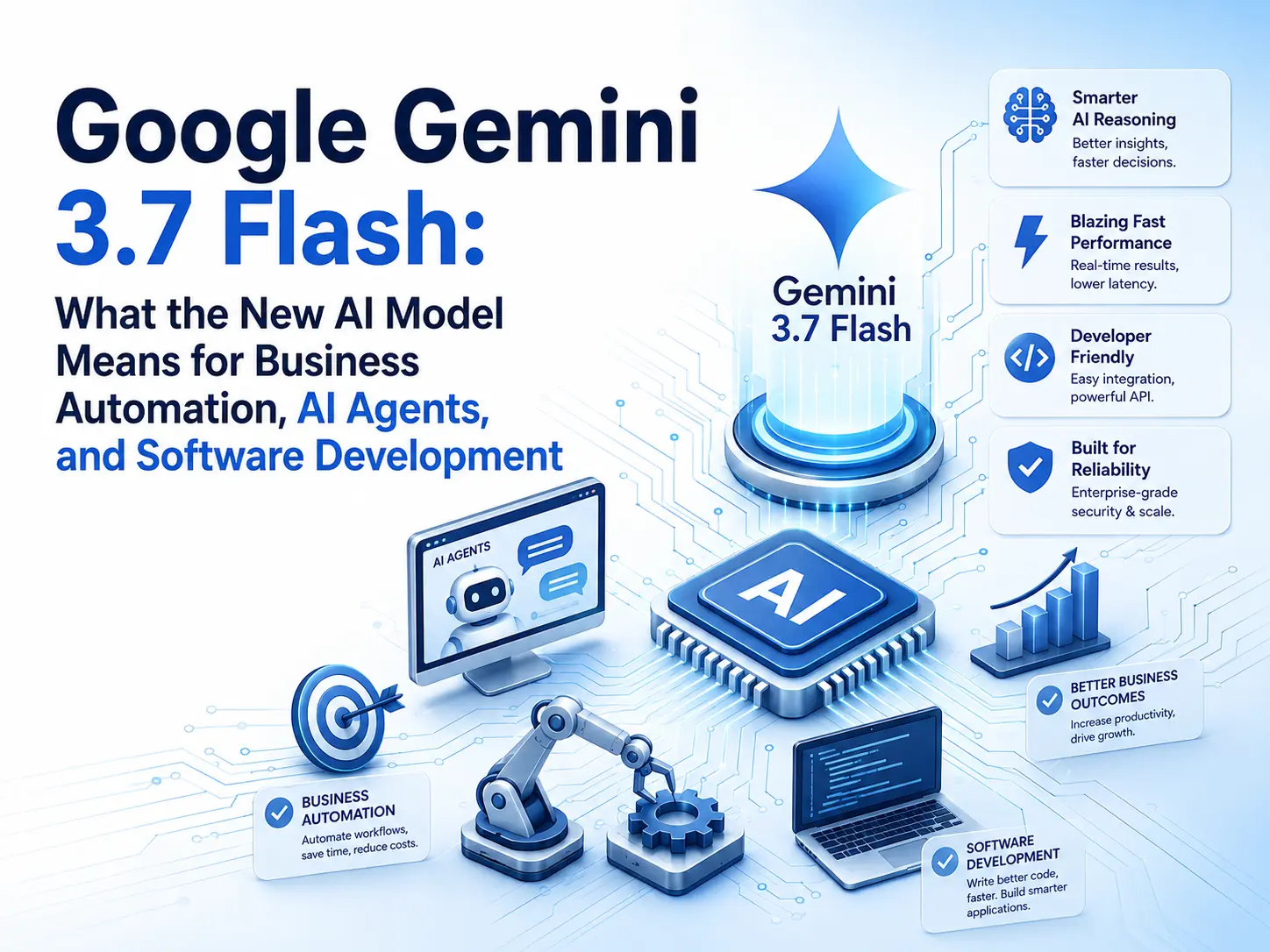
Google announced Gemini 3.7 Flash on August 13, 2026, positioning it as the company’s most capable workhorse model for coding and AI agents. The official product name is Google Gemini 3.7 Flash, although some people may search for it as “Google Flash 3.7.” The model arrived only three weeks after Gemini 3.6 Flash and is already generally available for production use through Google’s developer and enterprise platforms. Google’s announcement focuses on stronger software engineering, more dependable multi-step execution, improved web development, better document analysis, and lower introductory pricing.
For business owners, the important question is not whether Gemini 3.7 Flash earned a higher benchmark score. The useful question is whether it can complete real work with fewer failed attempts, less employee supervision, and a predictable operating cost.
That distinction matters. Many companies already use generative AI for drafts, summaries, research, and customer messages. The next stage is operational: connecting an AI model to business systems so it can retrieve information, follow a process, call approved tools, update records, and hand exceptions to a person.
Gemini 3.7 Flash is designed for that more demanding category of work.
This article examines what Google announced, what the model can and cannot do, and where it may fit inside a practical business automation plan. The analysis is based on Google’s official launch announcement, Gemini API documentation, and the Google DeepMind model card. Because model benchmarks do not guarantee results inside a specific company, businesses should test Gemini 3.7 Flash against their own data, rules, workflows, and risk requirements before deploying it broadly.
What Is Google Gemini 3.7 Flash?
Gemini 3.7 Flash is the newest version of Google’s Flash model line. Google describes it as a model built for complex coding, agentic workflows, and reliable multi-step execution. Its workhorse positioning makes it relevant to repeated production workloads where quality, speed, and cost all matter.
The production model ID is gemini-3.7-flash. It supports a context window of up to one million tokens and can produce text outputs of up to 64,000 tokens. It accepts text, images, audio, and video as input, which allows developers to build workflows that analyze more than typed prompts.
A large context window matters when a task depends on extensive source material. A company could provide product documentation, operating procedures, support records, policies, meeting transcripts, or a collection of files within one workflow.
The model still needs proper retrieval, permissions, and validation. A one-million-token window does not mean every available document should be placed into every prompt. It does, however, give developers more room to work with large source sets without dividing every long document into small, disconnected requests.
Gemini 3.7 Flash also includes adjustable thinking levels: low, medium, and high. Low is intended for faster, latency-sensitive work. Medium is the default and aims to balance reasoning quality with speed and cost. High allows more reasoning and tool use for difficult tasks, but it can consume more tokens and increase response time.
This control gives developers a practical way to match model effort to the value and complexity of a task. A fast customer-service classification does not need the same reasoning budget as an investigation into a software failure or a multi-document account review.
Why Gemini 3.7 Flash Matters to Businesses
The most important change is not a single feature. It is the combination of improved task completion and lower introductory cost.
An AI assistant that writes a reasonable paragraph but fails during a five-step workflow has limited operational value. A production agent may need to interpret a request, identify the correct customer or project, retrieve data from several systems, apply business rules, create an output, update a record, and request approval.
Each added step creates another opportunity for the model to misunderstand instructions, call the wrong tool, lose context, or stop before completing the process.
Google says Gemini 3.7 Flash follows instructions more accurately, adapts better when it encounters obstacles, and applies more effort to planning and tool calls than Gemini 3.6 Flash. Google connects this more disciplined execution with fewer retries and less manual oversight in engineering workflows.
In business terms, that could mean fewer situations in which an employee has to inspect a failed automation and restart it from the beginning. It could also allow an AI agent to handle more of a workflow before requesting human assistance.
It does not eliminate the need for monitoring. It may, however, improve the economics of automation by reducing failure handling.
Pricing also changes the evaluation. Through December 31, 2026, Google lists Gemini 3.7 Flash at $0.75 per one million input tokens and $3.75 per one million output tokens. Starting January 1, 2027, Google says standard pricing will be $1.50 per one million input tokens and $7.50 per one million output tokens.
The introductory rate gives businesses a defined period to test production workloads at a lower cost. Financial projections should still include the announced 2027 pricing rather than assuming the promotional rate will continue.
Lower token pricing does not automatically make an automation inexpensive. Total cost depends on prompt size, retrieved documents, reasoning level, output length, tool calls, retries, logging, infrastructure, and human review.
A low-cost model that repeatedly fails can cost more than a higher-priced model that completes the job correctly. Businesses should track cost per successful outcome, not only cost per token.
The Main Improvements in Gemini 3.7 Flash
Stronger Coding and Software Engineering
Google placed coding at the center of the Gemini 3.7 Flash announcement. The company reports gains in debugging, issue resolution, first-pass accuracy, and production-ready code generation.
Google DeepMind’s model card reports a FrontierCode 1.1 Main score of 43.6% for Gemini 3.7 Flash, compared with 34.4% for Gemini 3.6 Flash. On DeepSWE v1.1, which measures longer-horizon software engineering work, the reported scores are 65.3% and 48.6%, respectively.
These numbers suggest that the newer model is more capable of handling multi-step development work, not only isolated code snippets.
For a business, stronger coding performance can support several practical tasks. An internal development team may use the model to investigate bugs, write tests, review pull requests, explain legacy code, create integration scripts, or generate a first version of an internal tool.
A digital agency may use it to move from a client-approved design into working front-end components. An operations team may use it to create lightweight utilities connecting spreadsheets, customer relationship management platforms, ticketing systems, and reporting tools.
The model should not be allowed to deploy unreviewed code directly into production.
Generated code can contain security problems, incorrect assumptions, weak error handling, performance issues, or logic that works only in a limited test case. It may also select outdated or unnecessary third-party packages.
The better operating model is assisted development: automated generation and testing, followed by code review, security checks, and controlled deployment.
Better Web Development and Design Adherence
Gemini 3.7 Flash is also aimed at web development. Google says it can generate more functional layouts and feature-complete applications in fewer prompts. It is designed to follow screenshots, reference images, and complete design systems more closely when producing user-interface code.
The model card lists a Code Arena web-development Elo score of 1588 for Gemini 3.7 Flash, compared with 1538 for Gemini 3.6 Flash.
A benchmark cannot confirm that the model will reproduce a company’s exact brand system. Improved design adherence could, however, reduce the time spent correcting spacing, component behavior, responsive layouts, and visual inconsistencies.
This can be useful for small and midsize businesses with backlogs of website work. Common examples include building campaign landing pages, creating calculators or assessment tools, modernizing internal portals, producing customer dashboards, and turning approved design mockups into testable interfaces.
The benefit is not replacing the designer or developer. It is reducing the time between an approved idea and a working version that the team can evaluate.
Companies should still test accessibility, browser compatibility, mobile behavior, analytics, conversion tracking, page speed, search performance, and security. A page that looks correct in a screenshot may still fail keyboard navigation, load slowly, expose information, or break on smaller screens.
More Reliable AI Agents and Multi-Step Workflows
An AI agent is more than a chatbot. It receives a goal, plans actions, uses connected tools, observes the results, and continues until it completes the task or reaches a condition that requires human help.
Google says Gemini 3.7 Flash improves multi-step planning, tool use, instruction following, and recovery from roadblocks. The model is also the new default model powering Google’s Antigravity agent in Gemini Managed Agents and the Google Antigravity SDK.
In Google DeepMind’s model card, Gemini 3.7 Flash received a 30.4% AutomationBench score, compared with 17.0% for Gemini 3.6 Flash. The model card labels AutomationBench as a private evaluation set, so businesses should treat the result as a directional indicator rather than an independently reproducible guarantee.
The percentage itself also shows that agent automation remains difficult. A 30.4% benchmark result is an improvement, but it is not evidence that a model can safely run every business process without supervision.
The useful interpretation is that Google is making measurable progress on the type of multi-step work production agents need to perform.
Businesses can take advantage of this progress by starting with narrow, controlled workflows. An agent might qualify an inbound lead, prepare a draft proposal, summarize an account before a sales call, collect missing onboarding information, categorize a support ticket, or prepare a weekly operating report.
The agent should operate within clearly defined permissions. It should escalate exceptions rather than improvising outside company policy.
Better Document and Knowledge Work
Many business processes depend on documents rather than structured databases. Contracts, proposals, policies, annual reports, clinical notes, invoices, manuals, and project records often contain the information employees need, but finding and combining that information takes time.
Google reports that Gemini 3.7 Flash improved on GDP.pdf, an evaluation of complex PDF comprehension, from 22.0% for Gemini 3.6 Flash to 34.0% for Gemini 3.7 Flash. The model card also reports gains on several knowledge-work and long-context evaluations.
Combined with the one-million-token context window, this makes the model relevant for document-heavy workflows. It can help create a first-pass comparison of vendor proposals, extract obligations from agreements, summarize a long operating manual, organize findings from several reports, or convert source material into a structured draft.
The words “first pass” are important.
Document analysis can fail when tables are poorly extracted, pages are scanned, definitions change between sections, or a conclusion depends on a footnote. A model may also provide a confident answer even when the supporting information is incomplete.
Legal, financial, medical, and compliance decisions require qualified human review. The model can reduce reading and organization time, but it should not become the final authority.
Multimodal Input for Real Business Data
Gemini 3.7 Flash accepts text, images, audio, and video inputs. Its output is text. This expands the types of business information an automation can process.
A service company could analyze photos submitted with a support request. A construction firm could combine site images with written inspection notes. A sales team could summarize a recorded call and compare the discussion with account history.
A manufacturer could examine visual documentation alongside maintenance instructions. A marketing team could analyze a video transcript, on-screen material, and a campaign brief within one process.
Multimodal capability does not solve data quality. Blurry images, incomplete recordings, mislabeled files, missing context, and conflicting source documents will still lead to weak results.
Businesses need clear input standards and a process for flagging uncertain evidence. Employees should be able to see which files were used and correct the workflow when an input was incomplete or inaccurate.
Adjustable Reasoning for Cost and Speed Control
The low, medium, and high thinking settings are useful because not every task deserves the same amount of model effort.
A real-time website chat may need a fast response and can use a constrained knowledge base, making low thinking a reasonable starting point. A complex account review that combines several reports may benefit from medium thinking. A difficult code investigation or multi-tool exception workflow may justify high thinking.
Google recommends low thinking for latency-sensitive work, medium for most complex coding and agentic tasks, and high for difficult reasoning, mathematics, coding, and tool-use problems. Higher thinking effort may increase both token use and response time.
This lets a company create task-specific operating rules instead of using one model configuration everywhere.
The key is to measure the tradeoff. Higher reasoning effort may improve quality, but it can also increase cost and latency. A well-designed system routes simple tasks to a lower-cost configuration and reserves higher effort for cases where the additional reasoning creates measurable value.
What the Benchmarks Do and Do Not Prove
The early benchmark results are encouraging, but they require careful interpretation.
Google DeepMind reports gains over Gemini 3.6 Flash in production code quality, long-horizon software engineering, web development, enterprise workflow automation, complex document comprehension, long-context performance, and several agentic computer-use evaluations. These results support Google’s claim that Gemini 3.7 Flash is a stronger model for coding and agents.
However, the same model card shows that Gemini 3.7 Flash does not improve every reported measure. Its CharXiv scores for synthesizing information from complex charts are slightly below Gemini 3.6 Flash in both the no-tool and tool-assisted settings.
This is a useful reminder that a new model version is not automatically better for every workload.
Benchmarks are conducted under defined conditions. A company’s production environment includes its own prompts, documents, tool integrations, user behavior, security controls, response-time requirements, and error costs.
A benchmark win should earn a place in a pilot. It should not earn an automatic production rollout.
A reliable evaluation should include examples of normal requests, difficult edge cases, incomplete data, conflicting instructions, malicious inputs, and requests that must be refused or escalated.
The test should measure more than answer quality. It should measure successful task completion, factual accuracy, policy compliance, latency, token cost, escalation quality, and the amount of human correction required.
A model that produces better-looking answers but requires more employee correction may not improve the business. A model that completes a smaller number of tasks with greater reliability may create more value.
Practical Gemini 3.7 Flash Use Cases for Small and Midsize Businesses
Gemini 3.7 Flash is most valuable when connected to a defined business process. The following use cases are strong candidates for controlled testing:
- Customer-service triage that identifies intent, retrieves approved information, drafts a response, and routes sensitive cases to a person.
- Lead qualification that reviews form submissions, enriches records through approved sources, assigns a score, and creates a follow-up task.
- Sales preparation that summarizes account history, open opportunities, recent communications, and likely next steps before a meeting.
- Internal reporting that gathers information from approved systems, explains changes, and produces a draft weekly or monthly update.
- Software and website work that converts specifications or designs into testable code under developer supervision.
- Document workflows that compare proposals, extract structured fields, summarize long files, and highlight items requiring expert review.
These examples share several characteristics. They happen often, consume employee time, follow recognizable rules, and produce an output that can be checked.
They also allow the company to limit permissions and define when a person must approve the next action.
Customer Service and Lead Handling
A customer-facing agent can respond quickly, but speed is not enough. It needs access to current policies, product information, account status, and escalation rules.
Gemini 3.7 Flash may improve the model’s ability to follow a workflow across several systems, but the automation should still be restricted to approved actions.
For example, an agent could identify a billing question, retrieve the relevant account record, locate the correct policy, draft an explanation, and ask a representative to approve a credit above a defined limit.
The agent should not invent a policy or issue an unauthorized refund because it believes that action would be helpful.
The same approach applies to lead handling. The system can respond to an inquiry, gather missing details, classify the opportunity, and schedule the correct next step.
A strong design records why the lead received a score and lets the sales team correct the decision. Those corrections can then be used to improve the qualification rules.
Sales, Marketing, and Reputation Management
Sales and marketing teams often spend time moving information between tools and turning raw material into usable content.
Gemini 3.7 Flash can support research summaries, campaign drafts, proposal preparation, call recaps, and content repurposing. It may also help teams create personalized drafts using approved customer and account information.
The model can assist with review and customer-feedback workflows by classifying sentiment, identifying recurring issues, drafting a response in the company’s tone, and escalating legal or safety concerns.
It should not publish every public response without safeguards. Messages involving allegations, personal information, refunds, regulated claims, or legal disputes should be reviewed by an authorized employee.
For search engine optimization, Gemini 3.7 Flash can help organize topic research, map content to customer questions, create outlines, refresh outdated pages, and generate schema or front-end code for review.
It cannot guarantee search rankings. Search performance still depends on content usefulness, technical quality, authority, user experience, competition, and continued measurement.
Operations, Finance, and Management Reporting
Operations teams can use AI to gather updates, identify missing information, and create a structured draft of a management report.
A controlled agent might collect project status from approved systems, compare results with targets, flag exceptions, and prepare a concise summary for review.
Finance teams may use the model to explain variances, classify documents, extract fields, or prepare a first-pass narrative from verified figures. The model should not create financial numbers that are absent from source data.
Calculations should be performed by deterministic systems, while the language model interprets results and explains them.
This distinction is essential: use software rules and databases for authoritative calculations; use the AI model for classification, synthesis, drafting, and controlled reasoning.
Combining the two produces a more dependable system than asking the model to perform every step by itself.
Website and Application Development
Gemini 3.7 Flash may be especially useful for companies that have more software needs than developer capacity. It can help create internal dashboards, customer portals, workflow tools, landing pages, and system integrations.
A productive workflow starts with a clear specification. The model generates a first version, automated tests check expected behavior, a developer reviews the code, and a staging environment is used before release.
Security scanning, accessibility testing, performance checks, and version control remain necessary.
The model can shorten development cycles, but weak requirements still produce weak software. Businesses should define the user, goal, data source, permission level, expected output, error handling, and acceptance criteria before asking an AI system to build a solution.
Gemini 3.7 Flash Pricing and Availability
Gemini 3.7 Flash is generally available and identified in the Gemini API as gemini-3.7-flash. Google lists it across Google AI Studio, the Gemini API, Google Antigravity, the Gemini Enterprise app, and the Gemini Enterprise Agent Platform.
Individuals can also access the model through Gemini Spark in supported countries with eligible Google AI Pro or Ultra subscriptions. Google says Gemini Spark can use the model for tasks involving Google Workspace tools, such as consolidating files, drafting emails, and updating status documents.
The introductory API price is $0.75 per one million input tokens and $3.75 per one million output tokens through December 31, 2026. The announced standard price beginning January 1, 2027, is $1.50 per one million input tokens and $7.50 per one million output tokens.
A company evaluating the model in 2026 should build both price levels into its forecast. It should also estimate the full system cost, including database and search services, automation platforms, monitoring, storage, security, integration maintenance, and employee review.
A useful financial metric is cost per completed business outcome.
For a lead-qualification agent, that may be the cost per correctly qualified and routed lead. For a support workflow, it may be the cost per resolved ticket without a quality failure. For software work, it may be the cost per accepted feature or resolved issue.
These measures connect AI spending to business value.
Risks and Limitations Businesses Should Not Ignore
Google’s model card states that Gemini 3.7 Flash can still hallucinate. It may also experience occasional slowness or timeouts. Its stated knowledge cutoff is March 2026, although Google notes that knowledge in some domains may be limited to January 2025.
That means the model should not be treated as a live source of current facts unless the workflow connects it to verified, up-to-date information.
A company asking the model about current pricing, laws, schedules, product availability, account status, or breaking news should retrieve that information from a trusted current source. The model can then analyze or explain the retrieved information.
Google also reports updated safeguards for certain high-risk areas, including chemical, biological, radiological, nuclear, and cyber-offense misuse. Those model-level safeguards are important, but they do not replace a company’s own security and approval controls.
Before deployment, a business should define:
- Which data the model may access and which data is prohibited.
- Which actions the model may take without approval.
- Which decisions always require a qualified person.
- How sources, tool calls, outputs, and approvals will be logged.
- How the system will respond to missing, conflicting, or suspicious information.
- How performance, cost, errors, and user complaints will be reviewed.
The highest-risk mistake is giving an agent broad permissions before its behavior is understood.
Start with read-only access or draft-only outputs. Add write access one action at a time. Use approval gates for payments, account changes, public communications, legal commitments, health information, employee decisions, and other consequential actions.
An agent should also have a clear stopping condition. When information is missing, permissions are insufficient, or rules conflict, the correct behavior is often to request human help rather than continue guessing.
A Practical Adoption Plan for Gemini 3.7 Flash
A responsible rollout does not begin with “Where can we use AI?” It begins with a business problem that has a clear owner, measurable cost, and repeatable process.
First, select one workflow with enough volume to matter but limited downside if the automation makes a mistake. Document the current process, including the systems used, decisions made, exceptions encountered, and time spent by employees.
Second, create an evaluation set from real examples. Remove or protect sensitive information as required. Include easy cases, common cases, edge cases, and failure cases.
Define what a correct result looks like before testing the model.
Third, compare configurations. Test Gemini 3.7 Flash at different thinking levels and compare it with the current model or manual process. Measure quality, completion rate, response time, token use, and human correction.
Fourth, build controls around the model. Restrict tool permissions, validate structured outputs, use deterministic calculations, require supporting sources where appropriate, and create clear escalation paths.
Fifth, launch with monitoring. Review a sample of outputs, track failure patterns, and collect employee feedback. Update prompts, rules, retrieval sources, and approval thresholds based on evidence.
Finally, decide whether the workflow should scale.
The decision should be based on verified savings, improved response time, higher capacity, better customer experience, or reduced error rates. A successful demonstration is not enough. The automation should produce a repeatable business result.
How Perfect Business AI Can Apply This Technology
For many companies, access to a strong model is not the main challenge. The challenge is turning the model into a dependable system that fits existing operations.
That requires process mapping, integration design, data permissions, prompt and tool configuration, testing, monitoring, and employee adoption.
It also requires choosing the right model for each task. Gemini 3.7 Flash may be the right fit for a coding agent or document-heavy workflow, while a simpler model may be more economical for basic classification or message routing.
Perfect Business AI provides AI-powered marketing and business automation services that include AI receptionists, web chat, smart texting, AI-focused websites, customer relationship management, lead follow-up, reputation management, content marketing, SEO, advertising, and connected customer-engagement workflows.
The goal should not be to add an AI feature for appearance. The goal should be to reduce missed opportunities, repetitive work, slow response times, and disconnected processes.
A useful AI project should have an accountable owner, a measurable result, and a clear operating boundary. Gemini 3.7 Flash gives businesses another capable model option, but implementation quality will determine whether it creates value.
Conclusion
Google Gemini 3.7 Flash is a substantive update for companies building AI-assisted software, business agents, and document workflows.
Google reports gains over Gemini 3.6 Flash in coding, web development, enterprise automation, and complex document comprehension. The model also supports multimodal inputs, a one-million-token context window, adjustable thinking levels, and production availability through Google’s developer and enterprise platforms.
The lower introductory price makes the remainder of 2026 a practical testing window, but businesses should model the higher standard pricing scheduled for January 1, 2027.
They should also remember that benchmark scores are not production guarantees. Google’s own model card acknowledges hallucinations, possible timeouts, and uneven performance across some evaluations.
The best way to use Gemini 3.7 Flash is not to give it unrestricted control of a company.
Start with a narrow workflow. Connect it to trusted information. Limit its permissions. Measure completed outcomes. Keep people involved in consequential decisions.
When the process is designed correctly, a stronger model can reduce manual work, improve response times, and help teams handle more volume without lowering quality.
Perfect Business AI can help businesses identify the right workflow, connect the required systems, configure the automation, and establish the safeguards needed for dependable AI use.