
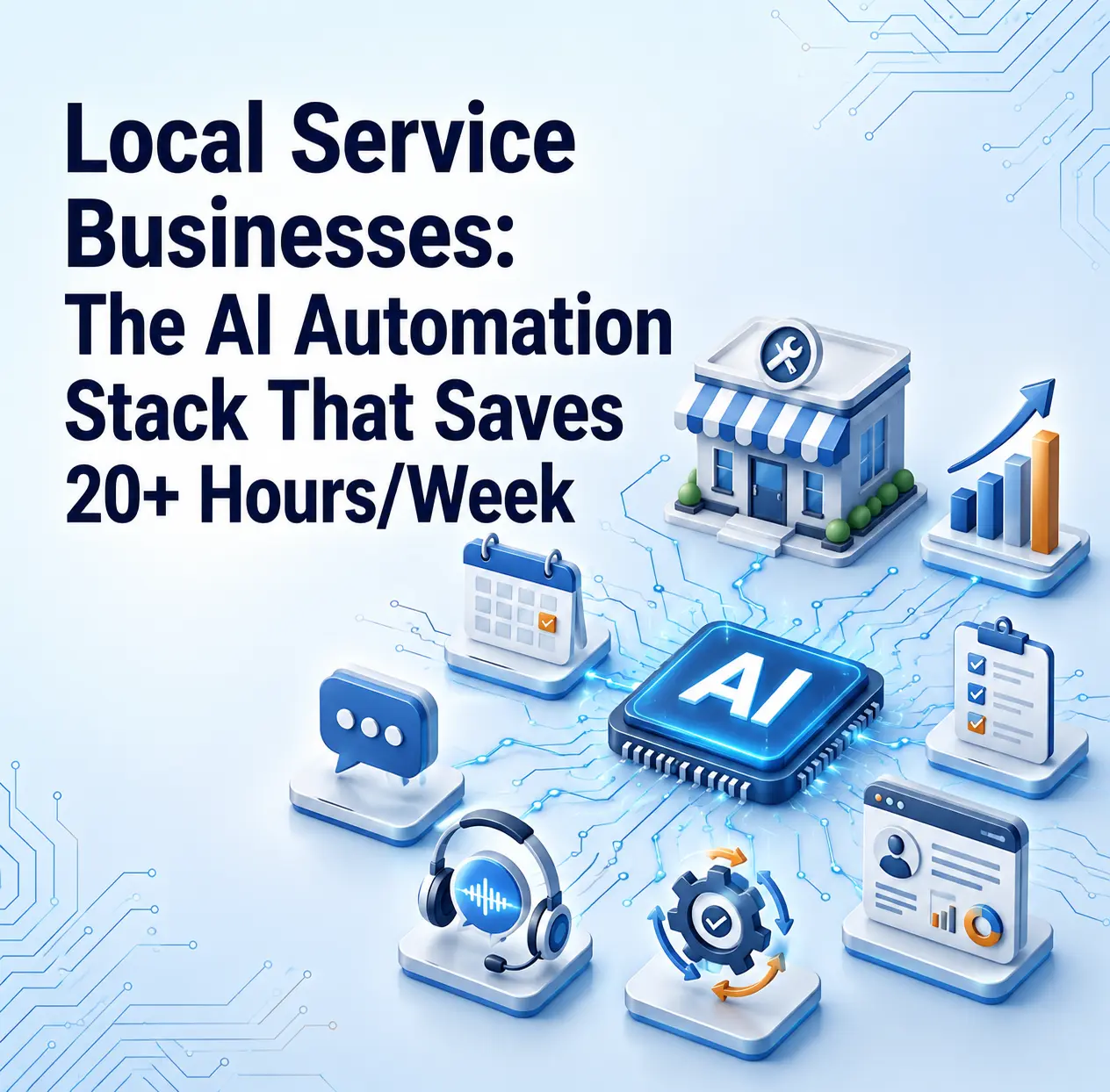
Running a local service business creates a strange problem. The company may be growing, the phone may be ringing, and new leads may be arriving every day, yet the owner and staff can still feel buried in administrative work.
Calls need to be answered. New inquiries need replies. Estimates need follow-ups. Appointments need to be scheduled. Customers need reminders. Reviews need to be requested. Leads need to be updated in the CRM. Website visitors need answers. Marketing campaigns need attention. Old prospects need nurturing.
None of these activities is unnecessary. The problem is that many local service businesses still handle them manually.
That is where AI automation for local service businesses can create a major operational advantage.
A properly designed AI automation stack does not replace the people who make a service company successful. It handles repetitive communication, routing, follow-up, scheduling, data entry, and marketing tasks so employees can spend more time on work that requires judgment, technical expertise, relationship building, and customer care.
For a busy local service business, recovering 20 or more staff hours per week can be a realistic target when automation is applied across several workflows rather than to one isolated task.
The important word is “stack.”
Installing one chatbot or adding one automated email sequence usually will not transform a company. The larger gains appear when the website, phone system, texting, CRM, calendar, review process, lead follow-up, and marketing systems work together.
Perfect Business AI is built around this connected approach, bringing tools such as AI web chat, AI receptionist capabilities, smart texting, CRM automation, appointment booking, reputation management, SEO, advertising, and other business automation functions into a broader ecosystem.
Here is what that AI automation stack can look like for a local service business and where the time savings can come from.
Why Local Service Businesses Lose So Much Time to Repetitive Work
Consider a typical plumbing company, HVAC contractor, chiropractic office, roofing company, restoration business, electrician, law firm, insurance agency, landscaping company, or other service-based organization.
A potential customer searches Google and visits the website.
They may submit a form.
Someone needs to respond.
Another person calls while the office manager is already speaking with a customer.
Someone needs to return the missed call.
A third prospect sends a Facebook message.
Another customer wants to reschedule tomorrow’s appointment.
A completed customer needs to receive a review request.
Three estimates from last week still need follow-up.
Meanwhile, the owner wants to know how many leads came in, where they came from, how many scheduled appointments, which estimates are still open, and whether the marketing budget is producing revenue.
Each task may take only a few minutes. Multiply those minutes by dozens or hundreds of customer interactions every week and they become a major labor expense.
The goal of AI business automation is to remove unnecessary manual steps from those workflows.
Instead of asking, “What employees can AI replace?” a more useful question is:
“What repetitive actions are employees performing every day that software could complete automatically?”
That question usually reveals a significant automation opportunity.
The Core AI Automation Stack for Local Service Businesses
A practical automation stack should follow the customer journey.
It should help capture attention, respond to inquiries, qualify prospects, schedule appointments, nurture leads, manage customer information, request reviews, and support ongoing marketing.
For many service businesses, the core stack includes:
- AI receptionist and phone automation
- AI website chat
- Automated SMS and email follow-up
- CRM and sales pipeline automation
- Online scheduling and appointment reminders
- Automated reputation and review management
- Marketing, SEO, content, and lead-nurture automation
The real value appears when these systems share information.
If an AI receptionist speaks with a prospect, that conversation should not disappear when the call ends. The contact should enter the CRM, receive the appropriate follow-up, move into the correct pipeline stage, and trigger the next action.
That is automation.
A collection of disconnected apps is not.
1. AI Receptionist and Phone Automation
For many local businesses, the telephone remains one of the highest-intent customer channels.
Someone calling an emergency plumber, electrician, restoration company, HVAC contractor, attorney, chiropractor, or other local provider is often doing so because they want help now.
The operational problem is simple: humans cannot answer every call instantly.
Employees may already be speaking with another customer. Technicians may be working in the field. Calls may arrive during lunch, after closing, early in the morning, on weekends, or during unusually busy periods.
An AI receptionist can become the first layer of that communication system.
Perfect Business AI offers AI phone and receptionist functionality designed around 24/7 call answering, routing, missed-call follow-up, and appointment-related workflows.
What an AI Receptionist Can Handle
A properly configured AI voice system can handle common interactions such as answering basic questions, collecting contact information, identifying the customer’s reason for calling, determining whether the inquiry fits the company’s services, routing urgent calls, scheduling appointments, and triggering text follow-ups.
The system should have clear boundaries.
A roofing company’s AI receptionist should not pretend to diagnose structural damage. A medical practice’s AI system should not independently provide medical advice. A law firm’s AI receptionist should not attempt to provide legal counsel.
Its purpose is operational.
Capture the inquiry. Gather the correct information. Route the customer. Schedule the next step. Notify the appropriate employee.
Where the Time Savings Come From
Suppose office employees collectively spend 90 minutes each business day answering repetitive calls, collecting contact details, giving basic information, checking calendars, and returning missed calls.
That is 7.5 hours per five-day week.
Automation does not need to eliminate all of that work to matter. Even reducing it by half would recover several employee hours every week while also providing coverage when employees are unavailable.
For companies with higher call volume, the savings can be much greater.
2. AI Website Chat That Works Like a Digital Front Desk
Many business websites still operate like online brochures.
They explain services, display a phone number, provide a contact form, and expect visitors to figure out what to do next.
An AI-powered website can take a more active role.
Instead of forcing a visitor to browse six pages looking for an answer, AI web chat can respond to common questions immediately.
A visitor might ask:
“Do you service my area?”
“Can someone come today?”
“Do you install tankless water heaters?”
“Do you accept my insurance?”
“How much does an inspection cost?”
“Can I schedule an appointment for Tuesday?”
If the AI system has been trained on accurate business information, it can respond and then guide qualified visitors toward an appointment, phone call, estimate request, or other conversion.
Perfect Business AI describes its AI web chat as a conversion-focused tool capable of engaging visitors, qualifying leads, and supporting appointment booking around the clock.
Chat Automation Reduces Repetitive Questions
Ask a receptionist which customer questions they hear repeatedly.
The list will usually become predictable very quickly.
Hours.
Service areas.
Financing.
Insurance.
Pricing ranges.
Appointment availability.
Emergency service.
Warranty information.
Directions.
Those questions are important to customers, but an employee does not need to manually type or speak the same answer 30 times every week.
Automating those interactions lets employees concentrate on unusual questions and higher-value conversations.
3. AI Smart Texting and Instant Lead Response
A new lead should not have to wonder whether the business received their inquiry.
Yet manual lead response commonly creates delays.
An employee sees the inquiry but is handling something else. The office gets busy. The lead arrives after hours. Someone assumes another employee responded.
By the time someone follows up, the customer may already be speaking with a competitor.
Automated texting can eliminate much of this delay.
When a website lead arrives, an SMS conversation can begin automatically.
For example:
A prospect submits a request for an HVAC replacement estimate.
The system immediately confirms the request and asks whether the customer prefers morning or afternoon appointments.
The customer responds.
The automation checks availability.
The customer schedules.
The CRM updates.
A confirmation is sent.
The employee does not need to manually perform each step.
Perfect Business AI’s platform specifically includes automated text conversations, email/SMS follow-ups, smart texting, and communication management as part of its customer engagement ecosystem.
4. CRM Automation: The Central Nervous System of the Stack
Automation becomes much more powerful when there is one reliable place to track each prospect and customer.
That is the CRM.
Without a CRM, customer information tends to become scattered.
One lead is in someone’s email inbox.
Another is written on a notepad.
Another exists in a spreadsheet.
Several text conversations are stored on an employee’s phone.
A Facebook lead has not been entered anywhere.
An estimate was sent last week, but nobody remembers to follow up.
A good CRM solves the organization problem. CRM automation solves the manual-work problem.
Perfect Business AI positions its CRM as a central hub for managing contacts, sales pipelines, conversations, email/SMS automation, and other customer interactions.
Automate Pipeline Movement
Consider a simple lead pipeline:
New Lead → Contacted → Appointment Scheduled → Estimate Sent → Won → Completed
Without automation, employees must constantly update records.
With automation, many stages can update themselves.
When a lead books an appointment, the record moves automatically.
When an estimate is sent, another workflow begins.
If the customer accepts, the opportunity moves forward.
Once the job is completed, a review request can be triggered.
The CRM becomes more than a customer database. It becomes the control system connecting the business’s sales and service workflows.
Why This Matters for Management
Automated CRM data also gives owners better visibility.
Instead of asking employees what happened to individual leads, management can inspect the pipeline.
How many leads arrived?
How many received responses?
How many scheduled appointments?
How many estimates remain open?
How many deals closed?
Where are leads getting stuck?
Good automation reduces administrative work while creating cleaner business data.
That combination is especially valuable for companies attempting to scale.
5. Automated Scheduling and Appointment Reminders
Scheduling sounds simple until a company handles dozens of appointments.
A customer requests Thursday.
Thursday is unavailable.
The employee proposes Friday.
The customer asks about Monday.
Someone checks the calendar again.
The customer chooses 10:00 a.m.
A confirmation is sent.
The customer calls two days later to reschedule.
That single appointment may require several interactions.
Multiply that by 20, 50, or 100 appointments per week.
Automated scheduling allows customers to move from inquiry to available appointment without requiring an employee to coordinate each step manually.
Once the appointment is scheduled, confirmation and reminder workflows can run automatically.
Perfect Business AI includes booking and calendar management functions that use automated customer communication to help turn inquiries into appointments and support follow-up through SMS and email.
Automation Should Handle the Routine, Not Every Exception
Scheduling automation works best when business rules are clearly defined.
Emergency calls may need immediate human review.
Large commercial projects may require a consultation.
Certain appointment types may require a specific technician.
Some services may need longer appointment windows.
The goal is not to force every situation through the same workflow.
Automate predictable cases and route exceptions to people.
That principle should guide the entire AI automation strategy.
6. Automated Lead Nurturing and Estimate Follow-Up
Many businesses spend heavily to generate leads and then lose potential revenue because follow-up is inconsistent.
This is one of the most preventable problems in local service marketing.
A prospect requests an estimate.
The business sends it.
The prospect says, “I’ll think about it.”
Nothing happens.
Thirty days later, the customer hires someone else.
The problem may not have been price or service quality. The competitor simply followed up.
AI automation can maintain polite, consistent contact without requiring employees to remember every prospect.
A follow-up sequence might include a message after the estimate, another reminder several days later, an email answering common objections, a final check-in, and then long-term nurturing when appropriate.
Perfect Business AI’s current positioning includes automated sales and persistent text and email follow-up as part of its lead-nurture approach.
Use Automation Without Becoming Annoying
More messages do not automatically produce better results.
Good automation must consider timing, context, customer preferences, consent requirements, and whether the customer has already responded.
If a prospect replies, “We hired someone else,” the system should not continue sending six sales messages.
If the customer schedules, the sales sequence should stop and the appointment workflow should begin.
Automation should make communication more relevant, not more repetitive.
7. Automated Review and Reputation Management
Local service companies depend heavily on trust.
A homeowner allowing a contractor into their property wants confidence in the company.
A patient considering a new chiropractor wants to see what other patients have experienced.
A customer choosing between two similar local businesses may compare their reviews before making contact.
The challenge is that satisfied customers rarely wake up thinking, “I should leave my contractor a Google review today.”
Businesses have to ask.
Employees frequently forget.
Automated reputation management solves that operational problem.
Perfect Business AI offers automated review-request and reputation-management workflows that can connect with existing CRM, scheduling, or job-management processes.
When a service is completed, the automation can send a review request.
If the customer does not respond, the system can follow up appropriately.
Employees do not need to manually send every request.
Reviews Can Also Feed Other Marketing
The workflow can go further.
Strong customer feedback can become useful material for website testimonials, social proof, social content, sales presentations, and other marketing assets when the proper permissions and platform rules are followed.
That allows one positive customer experience to contribute to future customer acquisition.
8. AI-Powered Marketing Automation
Operational automation saves time after someone becomes a lead.
Marketing automation can reduce the manual work required to generate and nurture future demand.
A local business may need service pages, location pages, educational blog content, email campaigns, social posts, search optimization, advertising management, and customer reactivation campaigns.
Attempting to manage each channel independently creates considerable work.
Perfect Business AI currently offers services spanning content marketing, SEO, AI optimization, Google Ads, websites, social media, reputation management, and related growth systems, allowing those activities to operate alongside CRM and communication automation.
The important point is not to generate more marketing material simply because AI makes production easier.
Effective AI marketing still requires strategy.
Content must match customer search intent.
Service pages need accurate information.
Advertising should target profitable opportunities.
Automated emails should address actual customer needs.
SEO content should demonstrate genuine expertise instead of publishing hundreds of nearly identical pages.
AI increases production capacity. Human experience should determine what deserves to be produced.
How the Stack Can Recover 20+ Hours Per Week
There is no universal time-saving number for every business. A company receiving 15 inquiries per week has a different automation opportunity from one processing 400.
However, consider an established service company with meaningful weekly lead and appointment volume.
The business may currently spend roughly five hours answering repetitive inquiries and missed calls, four hours following up with leads, three hours coordinating schedules, two hours requesting reviews, three hours updating CRM records, and several additional hours managing recurring marketing and customer communications.
That can easily exceed 20 hours of administrative effort.
Automation does not mean all 20 hours disappear immediately.
Instead, each workflow removes a portion of repetitive human effort.
Five minutes saved here.
Eight minutes there.
One call avoided.
One manual CRM update removed.
One scheduling conversation eliminated.
One review request sent automatically.
One estimate follow-up handled without employee involvement.
Across hundreds of weekly actions, small savings compound.
That is why automation should be evaluated at the workflow level rather than based on one dramatic feature.
An Example: What Happens Before and After Automation
Imagine an established HVAC company receiving a website inquiry at 7:42 p.m.
Without automation, the customer completes a form.
Nobody sees it until 8:15 the next morning.
An employee reads the message, enters the information into the CRM, sends a text, and calls the customer.
The customer does not answer.
Another follow-up is added to tomorrow’s task list.
With a connected automation stack, the same lead can follow a different path.
The customer submits the request.
Their information enters the CRM immediately.
An automated text confirms the inquiry.
The AI asks several qualifying questions.
The customer responds.
Available appointment times are presented.
The customer selects an appointment.
The CRM stage changes automatically.
The customer receives confirmation.
The appropriate employee receives notification.
Reminder messages are scheduled.
After the completed service, the review workflow begins.
A process that previously required several employee actions may now require human involvement only when the conversation reaches a point where expertise is needed.
That is the operational impact businesses should be looking for.
Start With High-Volume, Low-Complexity Tasks
Businesses sometimes approach AI backward.
They begin with the most sophisticated automation they can imagine.
A better approach is to identify the highest-volume repetitive work.
Look for tasks that are predictable, frequent, measurable, and rules-based.
Good initial automation candidates include missed-call responses, lead acknowledgments, appointment reminders, review requests, basic website questions, CRM record creation, estimate follow-ups, and dormant-lead reactivation.
Once those workflows are reliable, additional automation can be added.
The best automation strategy usually grows in stages rather than appearing overnight.
Keep Humans in the Right Parts of the Process
AI automation should not eliminate human contact where human judgment creates value.
A homeowner considering a $30,000 renovation may want to speak with a knowledgeable person.
A frustrated customer deserves thoughtful attention.
A complex legal, financial, medical, or technical question may require a licensed or experienced professional.
An unusual service request may not fit predefined automation rules.
The AI system should recognize these moments and escalate them.
Think of automation as a filter and coordinator.
It handles routine traffic so your employees have more capacity for conversations where their knowledge matters.
Data Accuracy and AI Training Matter
An AI assistant is only as useful as the business information it has been given.
Incorrect hours, outdated pricing, missing service areas, old policies, or inaccurate appointment information create poor customer experiences.
Before deploying customer-facing AI, businesses should establish an authoritative source for information such as services, locations, hours, frequently asked questions, scheduling rules, escalation procedures, financing information, contact information, and policies.
Someone should also be responsible for updating that information.
AI automation should never become a system that nobody supervises.
Measure Automation by Business Outcomes
Do not evaluate an AI system because it sounds impressive during a demo.
Measure what changes after implementation.
Useful questions include:
How quickly are new leads receiving a response?
How many missed calls are being recovered?
How many leads schedule without employee involvement?
How many hours of administrative work have been removed?
Are estimate follow-ups happening consistently?
Are more completed customers receiving review requests?
Is CRM data becoming more complete?
Are employees spending less time copying information between systems?
Has the number of forgotten leads decreased?
Those measurements connect AI adoption to actual operational performance.
Calculate the Financial Value of Time Saved
Time savings become more meaningful when translated into cost and capacity.
Suppose automation saves 20 employee hours each week.
Across approximately 50 working weeks, that represents about 1,000 hours per year.
The financial value is not limited to payroll savings.
Those hours can be redirected toward revenue-producing work.
Office employees can spend more time helping active customers.
Sales representatives can handle more qualified opportunities.
Technicians can spend less time on administrative communication.
Managers can focus on hiring, training, capacity planning, customer satisfaction, and profitability.
Owners can spend less time managing repetitive tasks and more time improving the company.
The goal does not have to be reducing headcount.
For growing businesses, the bigger advantage may be increasing capacity without adding administrative staff at the same rate.
Avoid the “More Software” Trap
Local businesses already suffer from software overload.
One system for email.
Another for scheduling.
Another for texting.
Another for reviews.
Another for CRM.
Another for website chat.
Another for social media.
Another for reporting.
Each tool may solve one problem while creating another: employees have to move information between them.
That defeats much of the purpose of automation.
The better strategy is consolidation and integration.
Perfect Business AI’s current service model specifically focuses on bringing website, CRM, AI receptionist, communications, reputation, advertising, and marketing functions into a connected business ecosystem rather than treating every function as an isolated tool.
For a local business, that architecture can be more important than any individual AI feature.
Build Automation Around the Customer Journey
The most effective AI automation stack mirrors the stages customers already move through.
A prospect discovers the company.
The website educates them.
Chat or phone automation answers questions.
Their information enters the CRM.
Follow-up begins.
An appointment is scheduled.
Reminders are sent.
The service is completed.
A review request is triggered.
The customer enters a retention or reactivation campaign.
Marketing data feeds future decisions.
Each stage should connect to the next.
When those transitions happen automatically, the business starts operating as a system rather than a collection of employees manually pushing information from one place to another.
AI Automation Is Especially Valuable as a Business Grows
Manual processes can survive at low volume.
An owner can personally follow up with five leads.
A receptionist can manually send 10 appointment reminders.
Someone can remember to request reviews from several customers.
Growth exposes the weakness.
Five weekly leads become 50.
Ten appointments become 100.
A single location becomes three.
Two technicians become 15.
The number of customer interactions grows much faster than the owner’s ability to personally supervise them.
Automation creates consistency.
Every lead can enter a process.
Every new inquiry can receive an acknowledgment.
Every scheduled customer can receive reminders.
Every completed job can trigger the appropriate next step.
That consistency is one of the biggest operational advantages of a well-designed AI stack.
The Competitive Advantage Is Speed Plus Consistency
AI itself is not the competitive advantage.
Competitors can purchase AI tools too.
The advantage comes from what the business does with them.
A company that responds quickly, follows up consistently, maintains accurate CRM records, makes scheduling simple, communicates clearly, collects customer feedback, and keeps its marketing active will generally operate more effectively than a company relying on employees to remember every task manually.
Automation makes those behaviors repeatable.
That is the difference between experimenting with AI and building an AI-enabled business.
What to Automate First
If your company is still heavily dependent on manual processes, do not try to automate everything on the first day.
Start with the workflows creating the most friction.
Track where employees spend time.
Look at missed calls.
Review unanswered leads.
Check how long inquiries wait for responses.
Inspect your appointment process.
Count how many completed customers actually receive review requests.
Look at old opportunities sitting untouched in the CRM.
Those gaps reveal where automation can produce immediate value.
Perfect Business AI offers a Free AI Blueprint designed to help businesses identify automation and growth opportunities and develop a more specific implementation roadmap.
The technology should fit the workflow.
The workflow should support the customer.
And the customer experience should support profitable growth.
Conclusion: Build a System, Not a Collection of AI Tools
The most important lesson for local service businesses is simple: AI automation works best when it connects the entire customer journey.
An AI receptionist alone can save time.
Automated texting alone can save time.
CRM automation alone can save time.
Appointment reminders alone can save time.
Review automation alone can save time.
But when those systems communicate with each other, the effect compounds.
A lead can move from website visitor to conversation, from conversation to CRM record, from CRM record to appointment, from appointment to customer, and from completed customer to review request without employees manually coordinating every transition.
That is how an established service business can realistically begin recovering 20 or more hours of repetitive administrative work each week.
The objective is not to remove people from the business.
It is to remove unnecessary work from their day.
Your employees should spend their time solving problems, serving customers, closing opportunities, improving operations, and building relationships—not repeatedly copying contact information, sending the same reminder, answering the same five questions, or trying to remember which lead needs another follow-up.
Perfect Business AI brings AI receptionist technology, web chat, smart texting, CRM automation, booking, review management, websites, SEO, advertising, content marketing, and related automation tools together to help service businesses build that type of connected system.
If your business is losing hours every week to missed calls, repetitive customer communication, manual scheduling, inconsistent lead follow-up, disconnected software, and administrative tasks, the next step is not simply adding another app.
It is building an automation stack designed around how your business actually works.
Start with the repetitive tasks consuming your team’s time. Connect the systems responsible for capturing and converting customers. Automate predictable actions. Keep people involved where judgment and expertise matter.
Then measure the result.
The right AI automation stack should give your business more than new technology. It should give your team something far more valuable: time.