
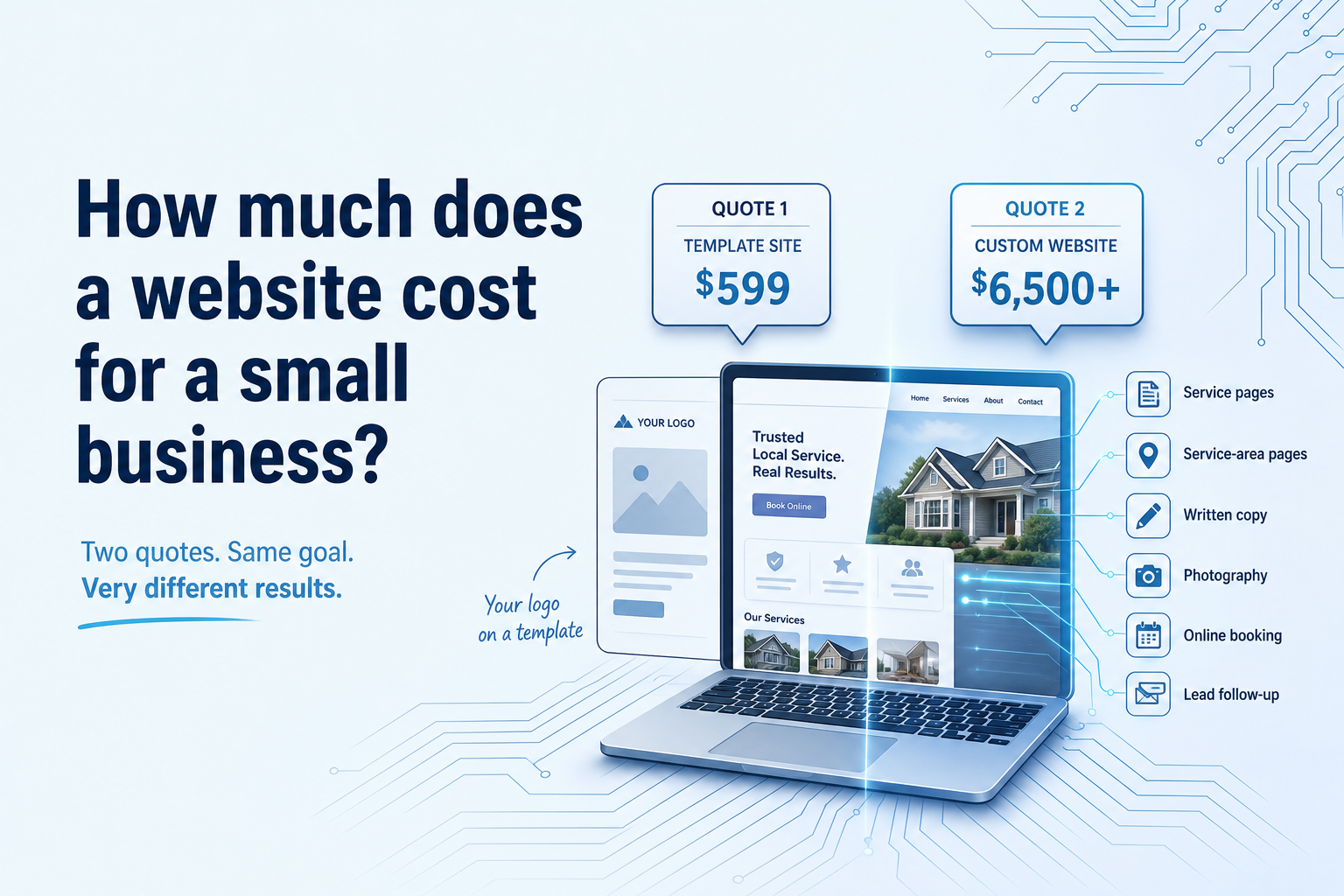
Website quotes for a small service business land anywhere from a few hundred dollars to the price of a used work truck, and the spread is almost never about greed. It is about scope. The cheap quote usually buys a template with your logo dropped in. The higher one buys service pages, service-area pages, written copy, photography direction, booking, and lead follow-up that actually fires. Read the spec before you compare the totals.
Why do two quotes for the same website land thousands apart?
You have three quotes on the desk. One you could put on a credit card without telling your spouse. One is several times that. The third sits in the middle and reads like it was written for a different company entirely. None of them explains what the extra money buys, and you are supposed to pick one by Friday.
Here is the uncomfortable part: those are not three prices for the same job. They are three different jobs that share a name. The low quote is typically a template, five pages, your existing text pasted in, and a contact form that emails you. The high quote may include a conversation about which of your services actually make money, a page for each of those services, pages for the towns you drive to, copy written by someone who interviewed you for an hour, direction on what photos to take, a booking flow tied to your calendar, and follow-up wiring so a form filled in at 9pm gets a response before your competitor calls back in the morning.
Owners are not imagining the confusion. Ask the question publicly and you will find it has already been asked. A thread in the Shopify community titled “What is a reasonable quote for a website redesign?” is one owner doing exactly what you are doing: holding a number they cannot judge and asking strangers whether it is fair. A long-running web design pricing poll on a hardware enthusiast forum shows the same pattern from the other side, with builders describing wildly different prices for work they all call a website. When the question keeps getting asked, it is because the answer depends on something the asker has not been shown.
So stop reading quotes as price tags. Read them as spec sheets. A quote is a vendor telling you, in dollars, which work they intend to do and which work they intend to leave on your desk. Once you can see that, the gap between two numbers stops being mysterious and starts being a decision.
What is actually inside a website quote
Almost every legitimate website project is made of the same work categories. Vendors differ in which ones they include, which they skip, and which they quietly assume you will handle. Here is what the line items mean for a service business.
- Discovery and scoping. Someone asks what you sell, which jobs are profitable, where your customers come from, and what a good lead looks like. Skip this and you get a pretty site that promotes your least profitable service.
- Information architecture and page count. Deciding what pages exist and how someone gets from the home page to booking a drain clearance in a specific town. Page count is the single biggest driver of hours on most builds.
- Design. Layout, type, colour, and how the thing looks on a phone in a van. This can mean a template lightly adjusted or original design work. Both are valid; they are not the same price.
- Copywriting. Someone writing the words on every page. This is the item most often missing from a low quote. “Client to supply content” is a sentence that has killed more website launches than any technical problem.
- Photography and image sourcing. Real photos of your crew, your vans, and finished work outperform stock. Either you have them, someone shoots them, or someone buys licensed images. All three are different lines.
- Build and mobile behaviour. Turning design into a working site, then making sure the call button, the form, and the maps behave on a phone, because most of your customers are on one.
- Forms and booking setup. Where does a submission go, who is notified, how fast, and does it land in a calendar or an inbox that nobody checks on Saturday?
- Tracking. Analytics, call tracking, and form tracking, so in six months you can tell whether the site is working instead of arguing about it.
- Testing and launch. Links, forms, speed, browsers, redirects from old URLs so you do not lose the rankings you already have.
- Training and handover. Showing you how to change a price, add a service, or post a job photo without filing a support ticket.
The three items most commonly stripped out of a cheap quote are copywriting, photography, and content loading. They are stripped out because they are the slowest, most human parts of the job. They do not disappear when they leave the quote. They move onto your calendar, usually at the exact moment you are busiest, which is why half-finished websites sit unlaunched for months with placeholder text still on the services page.
The questions that change your number
When you quote owner-operated local service businesses regularly, the same handful of answers move the price every time. None of them are technical. All of them are things you already know about your own business.
How many distinct services need their own page? A single-service operator and a firm offering nine services are not building the same site. Each service that deserves to be found separately needs its own page, its own copy, and its own proof. Three services is a small build. Nine is a different project.
How many towns do you want to be found in, and does each need a page? Service-area coverage is where a lot of cost and a lot of lead flow live. If you want to show up for a neighbouring town, something on the site has to speak to that town specifically. Listing fifteen place names in the footer does not do it.
Do you have usable photography? Photos of your team, vehicles, and completed work change both the price and the result. If they exist, that is hours saved. If they do not, someone is shooting them, directing you to shoot them, or licensing substitutes.
How do jobs actually get booked? Phone, form, text, or calendar? Each one has to be connected to something. A booking calendar tied to real availability is more work than a contact form, and worth more if your phone goes unanswered while you are under a sink.
Do reviews need to be pulled in? Live reviews on service pages are a build item, not a design flourish.
Does follow-up stop at an email notification? This is the biggest fork in the road. A site that emails you a lead is cheap. A site where the inquiry triggers a text, lands in a CRM, and chases itself if nobody replies is a bigger build and a different business outcome.
Is there existing content worth migrating? Fifty old blog posts, a photo gallery, and ranking pages all need decisions. Keep, rewrite, redirect, or bin.
Two electricians in the same city can land thousands apart on these answers alone. One wants four pages, has a phone that gets answered, and already owns good photos. The other wants eleven service pages, six towns, a booking calendar, and leads routed to a CRM. Same trade, different job.
Freelancer, DIY platform, or agency: why the source of the quote changes the price
You are realistically choosing between three routes. The honest way to compare them is not by price, but by what each one leaves on your desk.
A DIY platform is the lowest cash cost and the highest time cost. The subscription is small. The evenings are not. You are the one picking a template, fighting the layout on mobile, writing the services page at 10pm, and realising you need photos you do not have. Plenty of owners pull it off. Many more end up with a half-built site that stays half-built for two years, because the business kept being busy. If your time genuinely has no competing use, this route is fine. If you are turning down a quote to fiddle with a header, it is the most expensive option you can choose.
A freelancer is often good value for a clearly defined build. You get a skilled person, direct communication, and no account-management overhead. The risks are structural rather than personal. A freelancer is a single point of failure: one illness, one busy quarter, one career change, and your site has nobody. Follow-up wiring, ongoing changes, and marketing after launch usually sit outside the arrangement. Define the scope tightly and this route works well.
An agency or ongoing partner quotes a higher number because the scope includes the work the other two routes hand back: the writing, the photo direction, the booking setup, the tracking, and someone who is still there in month seven when a form breaks. You are buying capacity you do not have to manage.
The trade-off is not quality versus cheapness. It is cash versus your calendar. A busy owner’s evenings have a price, even when no one invoices for them. Decide which currency you would rather spend before you compare totals.
How much does a website cost for a small business? Three tiers, by what you get
The useful way to answer this is by what you are buying, not by vendor type. Three tiers cover almost every service business.
A credibility site
A handful of pages: home, about, services, contact. You supply the words and the photos. The job of this site is to exist, look current, load on a phone, and make someone who already heard your name feel comfortable calling. It will not generate inquiries on its own, and it is not supposed to. This is the entry point, and it is a reasonable choice if referrals already fill your schedule and your current site is simply embarrassing you.
A lead-generating site
A page for each service you want work in, pages for the areas you actually serve, copy written by someone who interviewed you, proper forms, and a booking path. Photos are either yours, directed, or sourced. Tracking is installed so you can tell what is working. This tier typically costs a multiple of the first, because the page count and the writing are a multiple. It is the tier most established service businesses should be looking at, because it is the first point at which the website does work rather than sitting there.
A site wired into follow-up
Everything above, plus the plumbing behind the form: inquiries routed to a CRM, instant text or call response, reminders, review requests, and a record of every lead so nothing falls through when three jobs run late. This is the most expensive tier because it is the most work, and it is the only one that addresses the problem most owners actually have, which is not a shortage of inquiries but a shortage of hours to answer them quickly.
You will notice there are no dollar figures printed here. That is deliberate. Any range on a public page is a guess until someone has asked how many services you sell, how many towns you want, whether photos exist, and where a lead needs to go. Ranges copied from industry surveys are how owners end up comparing a number on a blog to a quote for a completely different scope. Get a figure attached to your answers, not to the internet’s average.
What does a website cost per month after launch?
This is the line most owners forget until the first renewal notice arrives. Every site has a running cost, whether or not anyone told you about it.
- Domain registration. Small, annual, and the single most important thing to keep in your own name.
- Hosting and SSL. Where the site lives and the certificate that stops browsers warning visitors away.
- Platform or software subscriptions. Builder fees, plugin licences, form tools, booking tools, chat, call tracking.
- Security, updates, and backups. Software ages. Unpatched sites get defaced or quietly turned into spam relays, and a backup you have never tested is not a backup.
- Content changes. New service, new price list, new town, new photo from last week’s job.
- Anything that powers booking, texting, or lead routing. These are ongoing services, not one-time purchases.
There is a real difference between a site that just sits there and one that is maintained and added to. The first needs hosting and a pulse. The second needs someone whose job it is to notice things: that the contact form stopped sending after a plugin update, that a service page ranks on page two and could be rewritten, that the booking calendar has the wrong hours since you changed your Saturdays.
A quote with no monthly attached is not cheaper. It usually means nobody owns the site after launch. Owners discover this months later, often when a customer mentions they tried to get in touch twice and heard nothing. The form had been failing silently since March. Ask what the monthly covers and who to call at 7am when something breaks.
The hidden cost of the cheapest quote: paying twice
The cheap build frequently gets rebuilt. Not always, but often enough that rescue work is a recognisable category, and the patterns repeat.
Template sites with no service-area coverage, so the business never appears in the neighbouring towns it drives to every week. Forms that submit successfully and send the lead nowhere. Content locked in a page builder nobody can edit without the original developer, who stopped replying. No analytics, so nobody can prove the site is underperforming and everyone keeps assuming it is fine. Service pages so thin they say less than the business card.
When that site gets replaced, the second invoice is not the whole cost. Add the months of weak inquiry flow while it limped along, the work of migrating or recovering whatever content is salvageable, the redirects needed to keep the little search traffic that exists, and the time you personally spent chasing a builder who had moved on.
None of this makes an expensive quote automatically correct. Plenty of high quotes are padded, and plenty of modest builds do their job for years. The point is narrower: price per build is the wrong unit of comparison. Cost per useful year, including what you spent on it personally, is closer to the truth. Judge the scope, judge who is still around in month twelve, and then judge the number.
How to compare two quotes without guessing
Send the same questions to every vendor. The totals become comparable the moment the answers are on paper.
- How many pages, and which specific pages? Ask for the list.
- Who writes the copy, and is that included in this figure?
- Who supplies the photography, and what happens if I have none?
- What happens to a form submission: who is notified, how, and how fast?
- What is the monthly after launch, and exactly what does it cover?
- Who owns the domain, the hosting account, and the site files? Whose name is on them?
- What does a change cost after launch, and what is the turnaround?
- What is the timeline, and what do you need from me to hit it?
Question six matters more than it looks. If the answer is anything other than “you do,” treat the quote as a lease, not a purchase.
If you would rather skip the guesswork, ask for a quote where these variables are named up front: your services, your towns, your photos, your booking method, and where leads need to go. A number built on those answers can be judged. A number built on nothing cannot.